Tuesday, 21 February 2017

Star Trek - The Covenant of the Crown

'I'm just an old country doctor, not a Prince Consort.'
But she chose not to listen.  Instead she wrapped her arms around his neck and kissed him.  It was not an innocent kiss, and to his own surprise, McCoy returned it.

I don't know whether it's a good or a bad sign to be moved to tears before you have even started reading the story.  By the time I had reached chapter one there was a distinct wetness to my eyes and a thought I want to know you.  What Howard Weinstein and David Gerrold wrote in the first pages of his book in 1981 I agreed with, hell, I could have written even though I am over 30 years removed.

I guess, in a way I was sad too, that I wasn't around to experience that zeitgeist first hand.  Yes I feel that too!  Yes, I agree!  Let's carry on that conversation!  But here I am, stuck outside of that time, interacting with a sentiment printed on pages over 30 years old.  Is that conversation finished?  Can we start that conversation again?


Perhaps I was just in an emotional mood when I started  The Covenant of the Crown by Howard Weinstein, or perhaps he just gave form to thoughts I was having at the time.  I had started to read another book, but I was struggling to stay engaged so I switched to something shorter that would require less commitment (I really couldn't handle My Enemy, My Ally last week!).  Howard Weinstein holds the accolade of being the youngest person to have written the story for a Star Trek episode; Weinstein penned The Pirates of Orion which was the first episode of the second season of the animated series.  Knowing this, I wondered what format his novel would take - I wasn't disappointed!


For me, The Covenant of the Crown (#4 Pocket, #23 Titan) (1981) was a quick read.  It isn't a challenging story nor is it particularly long, the book weighing in at 191 pages all in, but what it lacks in length it makes up in character.  Simply put, Weinstein knows what elements make a Star Trek episode and exactly how much of each ingredient is needed to make it feel right.  Of course, I'm not saying by any means there isn't a place for the longer novels too - the ones that could never be an episode, as you know I do more like them! - but it is satisfying to be reading what feels like a slightly expanded TV episode.

At it's simplest level The Covenant of the Crown is a coming of age story, a young crown princess must take up her father's mantle and return to the kingdom she has been exiled from in order to stop the war that has choked her home land for many years.  However, put this well worn storyline in the context of Star Trek and it takes on a different flavour.  For one thing, the Klingons are involved and are directly responsible for the initial destabilisation of the planet, although it could be argued they just added fuel to the smoldering fire of malcontent.  There is also a slight clash of ideologies - a crown princess whose dynasty is ordained by the gods of her people, a mystical power which she must exhibit in order to be ruler of her planet - at odds with the somewhat more scientific approach of characters like Spock who explains the phenomenon away, or McCoy who doesn't feel the responsibilities of tradition should rest on her young shoulders.

Age is very much a theme, there is the obvious coming of age theme as mentioned above, but also old age or at least the approach of it is explored via the character of McCoy.  McCoy is preoccupied with his age, he feels his age, he realises that he's turning a corner and there's no going back to his youthful self, both in body and mind.  McCoy is often used in the novels as a vessel to explore the theme of age, such as in Dreams of the Raven.  However during the course of this novel McCoy falls in love with the princess and she with him; McCoy loves her sensitivity, her sponge like ability to absorb information and the princess loves his compassion, his passions and his good ol' country doctor charms.  Both McCoy and the princess show bravery in their relationship, McCoy shows the bravery of age, of wisdom, which allows him to pull back from the relationship whereas the princess shows the bravery of youth, which allows her to pursue a relationship no matter the age gap or the social barriers.  By the end of the novel she has also aged, she realises that her duty to her people must come first and, reminiscent of Kirk's withdrawal from his love affair in the TOS episode 'Elaan of Troyius' in deference to duty.  That in itself is an interesting comparison, Weinstein asks just how do these very different, but very lonely men deal with turning away from love? 

McCoy and Spock and the princess (Kailyn) have a rough adventure on the surface of a dangerous planet in order to retrieve the 'crown of the covenant'.  It's pretty much a perfect episode planetside romp, shuttle disaster, hostile natives, deadly weather.  McCoy gets to cuddle the princess for warmth while Spock exhibits his super Vulcan resilience.  Couldn't help notice that Weinstein conveniently forgot that Vulcans (even half Vulcans) are pretty rubbish in the cold, he did remember that Klingons hate it though.  It was quite a nice touch to have the pursuing Klingons effectively dealt with by bad weather, although I did somehow find myself cheering for a Klingon romance that ultimately wasn't to be.

The characterisation of Spock and McCoy's relationship is satisfying and more often than not funny.  Again Weinstein just gets it right.  They are satisfyingly antagonistic to each other, and without Kirk there they have to regulate themselves, or not as the case may be.

Kailyn (the princess) was actually a pretty tolerable female character - and I don't think that often.  She was a very well written female character and in a quite short story Weinstein creates a surprisingly deep and rounded protagonist.  She isn't trying to prove herself in opposition to men, she has to prove herself within her own boundaries, which actually turns out allows her to grow quickly and become more than equal to the men around her.  More female characters like her please!  Although her final actions are predictable (the story had to be resolved that way!) it still fit well and didn't seem shoehorned in.

For his part, Kirk remains on the Enterprise and so, takes a back seat (so to speak!) in this adventure.  Weinstein add a little back story to Kirk, giving him a history with the exiled king and the princess.  This same backstory effectively removes Kirk from being a potential love interest for Kailyn, which I'm not going to complain about.  Although McCoy is complaining about being old, it is Kirk who seems the most weighed down by time.  Kirk is very aware of the amount of time passing since the king went into exile, mainly by his urging and request, and very much seems to have the world on his shoulders. The storyline on the Enterprise takes an interesting turn when it is revealed that there is a Klingon spy and Kirk must find him before he can take any further action.

A further amusing subplot, involves a set of malfunctioning scales, just for a little humour to finish the book on!  Poor Chekov!

I think it's pretty obvious that I'm going to heartily recommend this book!  It honestly is worth the read, it will not take long and it really was enjoyable from beginning to end.  I really did like the pacing of the story, it didn't dwell too much on one thing and wasn't afraid to try to put a new spin on an old trope and make it work.

4/5 - Shine Bright Like a Diamond ~

Sunday, 5 February 2017

Star Trek - Triangle

Kirk tried fitfully to stir, alarm bells going off in his head.  It was always a mistake to think of the Vulcan as if he was human.  He was not.  What deadly Vulcanism did Sola and Spck know about, which Kirk did not?  Something which was triggered by what Spock  could not deny  he had felt for Sola?

I've calmed down a little bit, I promise!

... I promise nothing.

I really have neglected reading the earlier novels, so I turned to my partner and said -

"Choose from the following titles - " I listed the titles #3 to #9.

"Triangle?  It has to be Triangle - what kind of a name is Triangle anyway?"

And so I read Triangle (#9 Pocket, #49 Titan)  by Sondra Marshak and Myrna Culbreath.  I didn't hold out much hope for Triangle, I had to concur that it was a very strange name for a Star Trek novel.  However, as it turns out it wasn't something as innocuous as a title I had to be worried about.

As you may or may not know, Sondra Marshak and Myrna Culbreath were the two authors behind the William Shatner autobiography, 'Where no Man', and it isn't unknown that they have certain agendas.  They are also pretty notorious in the slash fandom some even going so far as crediting them for creating slash.  Typically I picked up the last book they penned together, soon after Sondra Marshak appears to have gone MIA - her former friends and writing partners don't appear to know where she is - and Myrna Culbreath went back to education and is credited with a phonics learning program.

-- Ok, maybe I'm not so impressed with that, I was forced to learn to read through a phonics program, and it didn't work for me at all  (I was instead taught to read at home by my mother without the use of phonics).  But it was trendy in the 80s and 90s so I guess I can't hold that against her... maybe. -- 

Sondra Marshak and Myrna Culbreath are intelligent women, and are/were highly influential within the ST fandom.  They are also quite academic and mix their own agendas and themes into the novels, -sometimes fairly hamfistedly, sometimes with a sledgehammer - and are very influenced by the psychological studies of the time.  They were involved in much trouble and controversy, which eventually saw them banned and alienated from conventions and publishers.  They were busy!

Marshak and Culbreath published four Trek novels

- The Price of the Phoenix (1977) - Bantam Books
- The Fate of the Phoenix (1979) - Bantam Books
- The Prometheus Design (1982) - Pocket Books
- Triangle (1983) - Pocket Books

They also have been involved in editing / contributing to two anthologies, while Sondra Marshak individually was involved in Star Trek Lives with Jacqueline Lichtenberg and Joan Winston.

Triangle is a hot, messy hurt/comfort fanfiction, and it's a little uncomfortable to read... ok, it's a lotta uncomfortable to read although it did cause me to laugh and be anxious in equal measure.  You might have gathered by other reviews, I am pretty protective of our illustrious Captain James. T... I don't like misrepresentation of him and I don't like to see him degraded for no reason.  I think Triangle really does cross that line.

I think I should fess up that I'm really not a big fan of hurt/comfort stories, although I do enjoy stories that have some of it in (I can't really deny that), I don't really like it when it's literally the kink  whole point of the story.

Triangle actually started out fairly interesting, and I was quite excited by the promise of a story which picks up the New Humans idea which is first introduced in the Star Trek The Motion Picture novelisation.  Since Marshak and Culbreath seemed to have a lot of contact with Roddenberry (and at the very least, Roddenberry knew of and/or used sections of the Kraith fanfiction), I thought that perhaps they would have more of an idea of where that storyline/idea would be going.  I guess I wasn't totally wrong they did have a really good idea that at times was a bit far fetched but at the same time 'very Trek'.

So essentially we are introduced to one of the New Human groups that essentially want to move towards a group consciousness.  An ambassador from the planet Zaran wants to be taken back to his planet by a representative of Starfleet - in this case their best - with the intention of testing them against his 'Oneness'.  There can only be one choice, Captain James T Kirk.  This seems like a pretty cut and dry mission, but wait!  The Enterprise will also have to pass through an area which is known as a starship trap, the 'Marie-Celeste' sector.  So there is story line number two, Kirk is going to experience the peril of the starship trap.

Seems like a nice set up... but it's pretty much down hill from there.

Understandably, Kirk's trials are taking their toll on him.  Not only is he physically exhausted and injured, but he is also being mentally assaulted by the Zaran ambassador Gailbraith.

Captain James T. Kirk saw the Vulcan's dark head and pointed ears bend over the scanners, and he took advantage of Spock's concentration to move, too carefully, from near the turbo lift doors to the command seat.   
Not that there was much the Vulcan was going to miss about his Captain, or ever had, but the last thing Kirk wanted just now was for Spock to read whatever the hell was going on with his Captain.  Fatigue, that was all.  And a few half-healed injuries - ribs cracked and the like.  He'd been banged up a little too much lately.  And not getting much sleep with those peculiar nightmares.  Once, one of the nightmares has started to come by day... Suddenly, now, it came again...
Kirk is never really in top form, even from the very first page of the first chapter he is on the back foot.  I can actually understand his fatigue, that's fine, we can surmise he's under mental assault so he's not incredibly sharp, but the thing is Marshak and Culbreath keep him weak throughout the entire novel.  I don't mean just physically weak, but mentally weak too, and in a situation where he has to represent the strength of individuality against opposing 'onenesses' it's a little... off putting.  They stop short at feminising him, which some commentators have suggested Marshak and Culbreath are fond of doing (The Prometheus Design?)  but they do ensure that Spock is always the stronger one even when he's battling against pon farr.  Yes, this novel is set seven years after the events in 'Amok Time' and as such Spock is suffering from the beginnings of pon farr's effects.  Nobody notices of course, because... reasons... but if Jims not careful he's going to have sexy times with his first officer.

What makes you think that Jen?  Well friends, it's not so much homoerotic subtext so much as homoerotic text.  You see in the above passage, the language of possession?  Well it doesn't stop there!  Spock saves Kirk multiple times, when their mental bond is broken he is agitated and worried, instead of allowing Kirk to be taken to sickbay by the medical team he carries him there himself...

And then he uh... deals with his issue with the cat person / woman / freeagent / half zaran with hugely powerful psychic powers who is also in love with Kirk... who is in love with her... who is also in love with Spock.  And you know how triangles are?  You know how it's  love triangle not a love chevron?  Well that part doesn't get left out either to be honest, but it's not gay if there's a woman involved right?  She's essentially camouflage for the Kirk/Spock shipping, that even gets commented on near the end of the novel.

I know I've kind of jumped ahead, but essentially there are two opposing forces Gailbraith's 'Oneness' and the 'Totality', neither are particularly good, but when choosing allies better to side with the devil you do rather than the devil you don't, right?  The cat girl  / free agent is needed by the totality in order to be a super powerful psychic conductor and enable the totality to forcibly absorb the minds of people in entire galaxies.  However, in order to unlock this power she needs to mate and bond with someone.  She ends up wanting both Spock and Kirk but ends up with neither, finally commenting that she wouldn't be able to go with one of them because it would mean monogamy, and it isn't for her sake she's saying that either.

Oh yes, a threesome is definitely implied, in fact I said to my partner, that I thought a whole scene  / chapter was missing, then later I read that someone believed there were extra chapters floating out there amongst certain circles...  I knew I wasn't just making stuff up!!

Triangle is very convoluted and nonsensical.  It's mainly concerned with a hurt/comfort relationship between Kirk and Spock (especially at the end... poor Kirk) and... if that isn't your kink, well... I think it's a bit lacking in any substance what so ever.  I think it could have been a very good idea if they'd developed the story instead of torturing Kirk but hey... what can you do?

2/5 - I'ma just gonna leave this here.

I need to pick a good one next... 

Friday, 3 February 2017

Star Trek The Motion Picture - Novel - Gene Roddenberry

I actually read this about six months ago, but I didn't want to write about it until I'd watched it again... and I didn't want to watch it again before I'd rewatched TOS.  So FINALLY I get to write about one of the most thoughtful and beautiful novels which just should be an essential counterpart to the film.

The Star Trek The Motion Picture novelisation is actually the only Star Trek novel Gene Roddenberry  wrote himself, which is both wonderful and sad - wonderful that we get to see his writing and ideas 'first hand' but sad because it is only the one novel, and he has a wonderful writing style.  One of the things I have read about Roddenberry is that he was a 'big picture' person - big ideas, but leaving the details to others - however this novelisation is all about the details.

My first introduction to the novel was actually via 'the Roddenberry footnote', which introduces the concept of th'yla - more on that later - of course I had to read the novel after reading just a footnote on it.  Following up the footnote subsequently caused me to read William Shatner's first biography Where No Man, which gives some insight to Roddenberry's thoughts going into the movie and the kind of influences on him at the time.  Incidentally the two women who wrote Shatner's biography (which takes the form of, in many parts, interview) are also the writers of a few Star Trek novels published through Pocket Books and I happen to be reading them at the moment.  They seem to stick very closely to the sentiments expressed by Roddenberry and Shatner as well as the details in the Star Trek The Motion Picture novelisation.

The reason I suggest that this novel should be an essential counterpart to the film is because there is a lot of explanation and expansion of scenes and characters.  For example, why are the characters in the transporter accident significant?  What happened to Kirk to change him from that charismatic leader to the dour, broken individual we see through most of the film?  What does Spock telepathically sense on Vulcan?  What were Spock's motivations for purging himself of emotions once and for all?  There's a whole host of questions left unanswered by the film that do have their answers in the book.

Now I'm not saying the film can't stand on its own per se,  it can, but reading the novel and watching the film (preferably the novel before the film) just makes the experience a helluva lot richer.  I feel that this novel is what novel adaptations of movies should be, not just a cash cow, not just rehashing the story scene by scene, but actually significantly adding to the understanding of the film.

It's significant that Roddenberry wrote this much expanded companion to the film.  It's significant new terms are introduced and it's significant that it overtly adds what the film couldn't due to trying to bypass the censors or because it was trying to appeal to a broad audience.

For your information, I consider this novel 100% canon.  If this can't be considered  canon, I don't know what can.

Before I dive headlong into my gasping appreciation of the Kirk/Spock relationship exposé, which frankly is the whole point of the film I'll point out a few things which make the film that much more comprehensible.

New Humans - knowing about the New Human movement goes a significant way into understanding just why Kirk is in the situation he is in.  You don't learn about this movement in the film, but you do in the book, and you also get an indication of the malleability of Human thought and importance of individuality in an increasingly homogenous society in the preface (written by none other than Kirk himself of course!!).  The implication is that Kirk was made an admiral and kept on Earth after the end of the five year mission as a figurehead representing the best of humanity and the pinnacle of individualism.  We get much description of how Starfleet and it's personnel are old fashioned and that the new and more advanced humans are moving towards almost a group consciousness and are wooed by greater intellects, something that we are told make them unsuitable for deep space exploration.  The New Humans are said to have been increasingly critical of Starfleet and Kirk was used as a pawn to secure support on earth.

McCoy left Starfleet in protest because they made Kirk an admiral despite his protests and his opinion that Kirk would not be suitable for the position:
'Upon learning that Admiral’s stars were to be offered to Kirk, McCoy had protested vehemently and had secured the backing of other prominent medical officers in the fight.'
McCoy resigned because his recommendations were ignored.  We don't know what happened in those last two years of the five year mission, but when Kirk got back, he wasn't the man we left at the end of the third season.  We also don't know what happened to make Spock leave (pfft), but we do know that Kirk couldn't process that at the time:
'Also, he had not really understood how deeply Spock’s abrupt departure for Vulcan had affected him. He had been depending on the Vulcan’s friendship and logic much more than he realized.'
 He (McCoy) knew his friend would be broken (and possibly was already broken) in his new position.  I have little doubt that McCoy realised Kirk was going to be used with little consideration to his mental health and as a doctor he couldn't stand by and watch it happen.

There are extra sections, extra insight from McCoy into Kirk's mental state in the book, and it is McCoy who redresses Kirk for his actions.  Their relationship needs time to heal, the slow speed in which it occurs however is a poignant indication of Kirk's broken state.

The novelisation adds significant observations from and about the rest of the crew which are not included in the film.  The original crew recognise that Kirk is different, that he's dangerous in his current state.  It's a testament to their belief and loyalty to him that they still follow him into the breach regardless, even when he has lost his charisma and charm.

We also learn about Lori, the woman who died during the teleporter malfunction.  Lori was Kirk's lover on earth in the first year after taking up his position in the admiralty.  She was sent to him by Admiral Nogura to 'heal and pleasure' him, which he accepted, however he knows that she was there to help control him on Earth.  He knows this, but is relatively unconcerned, he isn't vengeful he isn't angry, he just accepts it... he's completely dispassionate.  She was involved in Nogura's manipulation, which is made clear to him in scenes not in the film.

Of course, we also get a hell of a lot of insight into Spock's character, and into the relationship between him and Kirk.  In particular we get given the concept of T'hy'la and it's explanation in footnotes.  We also get told that T'hy'la is the term Spock attributes to Kirk - it means 'friend, brother, lover'.  I'm not going to go into an analysis of that now, that's a whole 'nother blog post, but we can safely say that at the end of the five year mission, something happened and Spock went running away to purge his 'shameful' emotions on Vulcan.  We get so much extra narrative about Spock's 'feelings' on Vulcan, we also get an explanation of what Spock 'hears'... He 'hears' Kirk thinking about him, calling out to him from Earth to Vulcan.  Spock fails to purge his emotions because of Kirk.

Spock refers to Kirk as his T'hy'la and all that implies, Kirk who lacks that word (presumably, otherwise I suppose he would have used it) he describes their relationship like this:
'But still it felt painful to be reminded so powerfully and unexpectedly of his friendship and affection for Spock - their had been the touching of two minds which the old poets of Spock's home planet had proclaimed superior to even the wild physical love which affected Vulcans every seventh year during pon farr.'
He lashes out at Spock when he is jilted, he wants to hurt him, but he also desperately needs him.  Even in this reduced capacity, once Spock is on the Enterprise again Kirk regains himself, and even Decker feels his respect towards Kirk increase.

Basically, if you want to learn about the inner workings of the characters, read this book, I'm barely touching on the additional content.

The novelisation has no qualms about the exposition of the two parallel  relationships of Decker/Ilia and Kirk/Spock.  None.  At. All.  The movie only thinly veils the comparison, the novelisation doesn't even bother.  And the overall theme of the movie?  That is basically sidestepped all the time (probably because of the two narratives) - love - you don't get to read that another way.  Love is referred to strangely in the movie / novelisation, have you noticed that Kirk calls even overt love 'friendship' - e.g. he calls Ilia and Decker's relationship 'friendship' and he hesitates and calls his relationship with Spock 'friendship' too.  I'm fairly sure that Kirk uses these terms interchangeably - much like the term 't'hy'la?  DAMN and I said I wouldn't get into this right now!

By the way, there are some extra parts to the um, 'sickbay scene' that make the whole thing completely 'un-misreadable'.  He is comforted, told that he didn't have to worry about 'shame', he 'clings' to Kirk, he feels 'needs'.

Q.E.D.  Roddenberry confirmed it right there.

The end of the novel plays out pretty much the same way as the film does.  There is an extra line at the end in which Spock banters with Kirk, indicating they are healed and that this is the start of more great adventures.

The novelisation is just... wonderful.  Wonderful companion, wonderful exposition, wonderful vindication.  Read it - I know I'm about to read it again!

5/5 - L.L.A.P

Thursday, 26 January 2017

Star Trek - Pawns and Symbols

Jean felt herself lowered suddenly, plunged into the dark.  She was totally disorientated.  The krelk released her into someone's arms.  "Jean!"  The whisper was Aernath's.  She clung to him convulsingly.

... Convulsingly?

It was about half way through Pawns and Symbols that I turned to my long suffering partner and said 'By God, I've found one, I've found a Mary Sue!'.  He laughed then, and we got into a discussion about the origin of the Mary Sue (he didn't realise that the term has its origin in Star Trek fanfiction) and whether this actually was a Mary Sue representation or not.  This soon spiralled into a mini -ongoing - research project, which then sidestepped into why 2009 Uhura is a poor representation of Uhura and a step backwards for female representation in Star Trek - ongoing project no. 2 - and then lept to the defense of slash ST fans everywhere.

And that was only half way through the book.

Pawns and Symbols (#26 Pocket, Giant #4 Titan) (1985)  by Majliss Larson really has to be read to be believed.  There were many times when I realised my mouth was agape, stunned by what I had just read, others where I had to screw up my face to try to release my muscles from a near constant smirk.  I gave a running commentary to my partner, complete with predictions of what I thought would happen next (it wasn't hard), and proclaimed loudly that I had found 'Twilight in Space'.  How about 'Wrath of Mary Sue'?  No? OK.

Firstly, I'm going to get this out the way.  It's definitely a woman writing, and I think the name 'Majliss Larson' is a pseudonym.  I've looked in my usual places and she doesn't appear to have an online presence or any other reference to her aside from Pawns and Symbols.  To be fair, if I was wrote Pawns and Symbols under my own name, I probably would have legally changed it by now, or invoked something like 'right to be forgotten'!

I have to be fair though, it isn't the worst Star Trek novel I've read (and that pool is increasing), but it is the most blatant Mary Sue / Author Proxy / Self Indulging one so far.  About 90% of the book is taken up by misadventures of Jean Czerny - young, botanist, amnesiac, genius, Klingon whisperer, super attractive to Klingons, can beat a Klingon in a knife fight... need I go on?  Her ridiculous romances with out of character Klingons are set within the theme of 'stranger in a strange land'.  Jean has to adapt to life as a captive in hostile territories and in the process exposes the political machinations and mentalities of Klingon society...

...While banging Kang.  Whilst falling in love with the most gentle Klingon ever with blue eyes (later they are described as amethyst as Larson forgets what she wrote earlier in the novel).  You know what?  I'm not even really spoiling it if I tell you that by the end of the novel after smexing Kang one final time, she gets with the pretty Klingon.  Why am I not spoiling it?  Because Jean is a Mary Sue, loud, proud and (probably) unashamed, and if you rouse your inner teenage fangirl she will inform you what the next 'plot twist' will be.

The tag line for the novel is deceptive:

THE KLINGONS ARE HUNGRY FOR WAR - 
AND KIRK IS CAUGHT IN A BRUTAL BATTLE OF WITS!

I actually believed that I was going to get a clever story this time!  A battle of wits!  Perhaps I was going to be treated to Kang and Kirk butting heads, out maneuvering each other with a grudging respect.   The title Pawns and Symbols sounds exciting and the cover, Kirk, Kang and a chess board, complete with 'chess piece' Jean, wheat, and the Enterprise was intriguing.  There is no battle of wits between Kirk & Kang, because Kirk gets barely any story time, the original crew get barely any story time!  There is one section where the Enterprise rescues a Romulan woman, but this feels like filler, almost as if Larson was told 'look here, this in a Star Trek story, you need to actually put the Enterprise Crew in it!'...  And she does but... it's not so much shoehorned in as crowbarred in.  Spock does have a slightly larger role in a strange episode while posing as a Romulan on a Klingon planet...

Essentially, Pawns and Symbols paints a sympathetic picture of the Klingons, and that they are are essentially a good, kind people who war with an aggressive nature.  Also they are seemingly muslims who treat women as chattel and in some areas are forced to wear clothing very similar to the burka.  Women are also written as second class citizens, forced into a subservient attitude - I'm kind of glad that TNG didn't go down this route with female Klingons!

In this story, the Klingons are in a position of desperate need.  They have caused famine on their planets with alteration of their grain strains but do not wish to seek help because they do not want to bargain from a position of weakness.  This is why they keep Jean Czerny as a hostage, as both a bargaining chip and a resource.  Afterall, she is a genius botanist and will be able to help them use a new resistant type of grain succeed on the various affected planets.  Jean is held captive out of necessity for about 6 months, and in that time, makes enemies, becomes Krang's consort, falls in love with Aernath, adopts a Klingon orphan...

Memorable(?) moments:

- Kang cutting her clothes off her the first time they met.
- The 'I'm too scared to write fallacio so this will have to do scene'.
- The it's not rape, it's coerced sex scene.
- 'I'm screwing Kang, but I sure do hope Aernath is jealous' moments.
- Jean seriously scolding herself in the shower and Kang coming to the rescue.
- All the times we didn't have to know Jean needed to go / went to the toilet.
- Mara (Kangs estranged / now not estranged) wife being totally cool and sisterly about Kang screwing Jean.  Surprised she didn't suggest a menage a trois, all the other Klingons love her.
- Jean being made to strip for Kang after being seriously injured.
- All the teeth grindingly terrible variations of 'speaking another language' through sex.
- Injury is this author's kink.
- A bizarrely long episode about Klingon colour blindness that has no actual bearing on the plot, except perhaps making Aernath look more fragile and adorkable.
- Tribbles.

Luckily, this whole debacle is easily written off, as much of its musings about possible Klingon culture and such is smashed a couple of years later with Next Generation in 1987.  As such, Pawns and Symbols has not aged well.  I feel that this book got published 'under the radar' as it were, since we know that Roddenberry (or at least his team) cracked down on the novels after being triggered by Killing Time's homosexual tendencies.  Killing Time was number 24, Pawns and Symbols is number 26, there would have been only a couple of months between them, I doubt whether the editorial mess would have been cleared up in time for this book to have been filtered out or had any editing.  Actually, I'd be surprised if this book had any proofreading or editing at all.  There are so many typing errors and sentences that make absolutely no sense littered throughout, at times I found myself wondering what had just happened.

Frankly I found myself wondering how this book ever saw print.

I've got to give credit where it's due though.  Whoever Majliss Larson is, I think she really cared for this story; I think it meant a lot to her, I think she tried hard.  That doesn't change the fact it's bloody awful, but you do get a sense that it wasn't a throw away novel for her.  In fairness, she tried to show more of the universe by putting a new character in a difficult situation and was able to increase the time passing in the novel as part of that - I haven't had another ST novel in which the event spanned 6 months... yet.  She did try to add a quite a complex society to the Klingons, which could have worked, but her vessel - Jean 'Mary Sue' Czerny - was not the best choice.  Frustratingly, I could see ways in which the narrative could have been improved, she had good ideas that if told more from the perspective of the Enterprise crew could really have worked.

Consequently, I really don't think this is a recommended read unless you're interested in strange OOC Klingon centric stories, and even then you've got to have a high Mary Sue tolerance to reach the end (I was struggling!).

1/5 - Kang bang...?

Wednesday, 18 January 2017

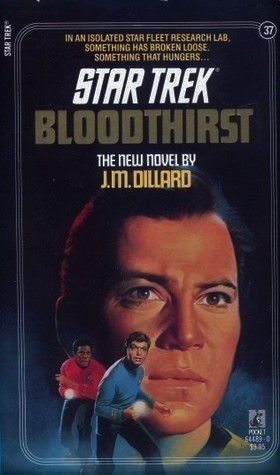
Star Trek - Bloodthirst

'Maybe it was an illusion created by the shadows, but the man's skin was gray, the expression pinched - like a corpse, McCoy thought, like a med school cadaver that'd been taken out of stasis and left lying around the classroom too long.'

Bloodthirst (#37 Pocket, #6 Titan) (1987) by J M Dillard is a vampire themed addition to the Star Trek novel series (as if you couldn't tell from the title) which I tried to hate, wanted to love and ended up with mightily confused feelings on the whole experience.

Back up.  Back up.

Bloodthirst is a book of contrasts, not just thematically but also in how successful Dillard is in writing.  The first half of the book is an uninteresting slog that takes far too long to get moving, but the second half is strong and keeps you turning the pages.  Misdirection of the reader promises a complex plot,  but in the end the simplest explanation was the correct assumption (Dillard appears to lose herself along the way).  Annoying 'OC' crewmembers take up far too many pages with their seemingly endless soap opera, but somehow I end up caring about two of them by the end.  And so on and so forth.  I'm pretty conflicted.  I feel like everytime I come up with a criticism, something else mitigates it, and when I find something I like I can recall something to the contrary immediately.   

It's not like Dillard was the new kid on the block at this point either.  J M Dillard is a pseudonym of Jeanne Kalogridis and Bloodthirst was actually her third Star Trek novel published.  Her previous titles were Mindshadow (1986) and Demons (1986) in which she develops two of her OCs Nguyen and Tomson.  I haven't read those two novels yet, so I can't really comment on them, but I am kind of looking forward to seeing how her writing developed (if it did).  Kalogridis (as Dillard - referred to here on only as Dillard) went on to write two more ST:TOS novels of her own devising and several ST movie novelisations, and many more stories set in the Star Trek universe.  She also has written her own original stories, including a few vampire ones.

It's funny, because as I was reading it (especially the first half) I was thinking that Dillard writes a lot like Vonda McIntyre, because of her overbearing original characters, and she ends up doing the novelisations for the films, just like old Vonda did.  She also, unless I am very much mistaken, also references one of Vonda's OCs Snnanagfashtalli (also seen/mentioned in 'Uhura's Song') two or three times in passing, but I'll be damned if I can find those references again, I should have put a sticky when I noticed them.  I have to admit that her likeness to Vonda McIntyre soured me a little towards her, but she managed to somehow mollify me later.  I should explain, I spent much of the first half of the novel wondering whether I should give Bloodthirst a 1 or 2 / 5.  I thought 1/5 would be a little too harsh, and that it was a solid 2... but somehow Dillard turns it around in the second half and Bloodthirst claws its way to 3/5.

Now I have to admit, I really do like Vampire stories, but, do they do well in Star Trek? Well, it's not like we haven't seen them in the TV series itself - what about the salt vampire?  The concept is the same, a parasitic creature who can pass as human and then attacks, usually killing the victim, sometimes creating more of themselves.  Bloodthirst takes the concept of vampire and tries to 'sci-fi' it with varying levels of success.  What I do like is the whole 'vampirism' as a disease and medically explicable, it's still scary without the mysticism - it might actually be more scary when talking about a potential plague - but I think it was a mistake to try and shoehorn the vampire mythos in.  Dillard feels the need to explain the mystical vampire by having Spock explain it, and then later Chekov reveals his crucifix (given to him by his Russian grandmother, naturally) which means he'll be safe.  Urgh... if the crew aren't bothered with the mystical aspect, either because they are ignorant of folklore / literature (which always bothers me when it comes up, why do they always have no idea of these things?) or they simply have no time for it when it can all be solved with an inquisitive mind and science.

It's not a secret that the 'vampirism' is a man made virus, that is clear from the beginning, what's more pretty early on Kirk, Spock & McCoy realise that they have stumbled onto a bio-weapon hot lab associated with Starfleet.  They are also right on the money when they name an initial suspect, although Kirk uncharacteristically flip flops between trust and distrust.  Dillard tries to throw red herrings out, but they are easily identified as such, and consequently much of the time I spent cursing the characters for their epic shortsightedness.

Speaking of characters, Kirk, Spock and McCoy were at times weakly written, which I think is a symptom of authors wanting to write their original characters how they wish and then bending to established characters to support their creations.  This weakness is confirmed as the story progresses, and the OCs take a step back and Kirk, Spock and McCoy wrestle control of the plot.  That being said, I did get attached to one of the characters - Stanger - who I thought was particularly well constructed.  However, as nice as he is he doesn't quite merit the amount of time lavished  on him and his companions  at the expense of good characterisation of existing characters.  I feel that they could easily have been substituted for other members of the bridge crew (who get very little time), which would be preferable to the security personnel soap opera, which kind of feels like 'upstairs, downstairs' in space.

The villains are a little wishy-washy, their motivations a little weak.  The 'vampire' is a pretty sinister character, satisfying to hate, but the other main villain (and his allies in Starfleet) is unconvincing.  The motivations of these people to do what they were doing was only understandable to a point, the scale in which they wanted to revenge themselves was far fetched and unreasonable to the extreme.

Additionally, there are many loose ends, for example the Vulcan spy, Sepek, or the fact that Starfleet knew about the research (because of Sepek) but did not step in to avoid pointless deaths or take any action.  Kirk was essentially left to his own devices and Starfleet stayed silent.  This just seemed very clumsy - Waverleigh didn't have to die, it was painfully obvious what was going on, why didn't Starfleet intelligence intervene?  How did the admiral and assistant get to Tanis?  Where was the ship which got them there?  How were they going to get away with it... we'll never know!

Anyway... Bloodthirst is ok.  Decidedly middling, nothing to really write home about, but not particularly offensive either.  I mean, you could always do worse I suppose?  If you like vampire stories you might want to give this one a go or, perhaps if you like 'strong' original characters then this might suit you.

3/5 - No Dracula

Wednesday, 11 January 2017

Star Trek - Dreams of the Raven

'When the deck tremors began, the first officer was already braced for the movement but McCoy immediately lost his balance.  Above the whine of the ship's engines came the shatter of glass hitting a far wall and the crack of bone against metal.'

Dreams of the Raven (#34 Pocket, #3 Titan) (1987) by Carmen Carter is a strong character driven tale which also has a well crafted plot, if at times arguably cliched. Although the book's focus is McCoy there is also a great deal of character development for Kirk, Spock, and even Nurse Chapel.

Carmen Carter is better known for get Star Trek TNG novels, having penned three.  She has also written a few short stories and a good many Star Trek themed essays!  I think some will be easier to get hold of than others (Vulcan as a Meritocracy (1986)) but I want to at least read a couple!


I didn't really know what to think when I (belatedly) picked up Dreams of the Raven for the first time, but the blurb intrigued me and the cover is unusual... though not 'pretty' by my definition!  However, I do like the expression on McCoy's face... but I am a little confused with what Kirk is doing here, since it has zero bearing on anything in the story.  The ships in the background kind of  illustrate a scene in the novel... kind of.  I did think that Dreams of the Raven was going to be another 'supernatural' type story like Ghost Walker... I was fooled!  Well, it seems if you're like me and choose Star Trek novels by their covers, you'll always be surprised by the content!

I've often wondered what kind of briefs were given to the artists for these covers (as you know) because sometimes they are somewhat offbeat, but also who comes up with the tag lines?  The editor?  The author?  Someone paid outrageous sums of money to read books and come up with exciting but usually inaccurate statements?  And do they also write the mostly inaccurate blurbs?  I'll ask an author friend of mine and get back to you!

I feel obliged to inform you first that I didn't like this novel, I LOVED IT.  From the first page of the prologue to the very last page of the final chapter and when I finished it, even though I knew the story had reached it's conclusion and tied up all its ends neatly, I wanted more.  It ended too soon.  Dammit Carter, why did you only write one TOS book?!  I could have read a series of books by her, she has a real gift for writing characters, she can write suspense, she handles combat scenes with consummate ease and she manages to make it look easy.

The story on it's own was rather good.  The Enterprise is docked at a civilian station when they receive a distress call from a Frenni merchant ship.  The Enterprise goes to the aid of the civilian ship but instead is ambushed.  The civilian ship rams the Enterprise - which is only saved by the virtue of its shields - crippling a nacelle and effectively disabling the ship's warp capabilities.  Low on power and hobbled the crew of the Enterprise must fend off alien attacks whilst trying to work out what these new and terrifying aliens are and what they want!

Meanwhile, McCoy suffers a head injury which seemingly causes him to suffer from amnesia, making him forget the last twenty five years of his life!  However, the true cause of his reversion to his twenty four year old self is not as simple as a bump on the head, and relates more to the terrifying new aliens than anyone (even he) realises.

That's it.  That's all I'm going to tell you story wise, because it'll be truly spoilt otherwise.  It's worth reading - do it.

Carter manages to tap into the rhythm of the characters - she doesn't miss a beat for example when Spock and McCoy are having a tiff you just know what is going to come next and she isn't afraid to show the effect of McCoy's absence on Kirk, or even Spock whose emotional response is keenly observed by his friend.  Dreams of the Raven presents a broken trinity in a way that simple death or belief of death doesn't manage, because McCoy is alive an well in front of them but is unreachable.  The palpable sense of loss from Kirk is heart breaking, especially as the McCoy in front of him hasn't matured enough to respect him as a Captain, let alone ever consider him close friend material.  I think Kirk suffers more here, isolated as he is from his confidante, friend and sounding board.  Carter implies something touching, that Kirk's strength is drawn from his two friends, when one is missing he is plagued with doubt.  Kirk of course isn't so dependant that he can't function under the circumstances, we know his will is greater than that, but we can see that his victories come with more of a struggle, and his confidence in his own decisions wavers, even with the acceptance of his first officer.

Spock's loss is tacit, not characterised by emotions like Kirk's roiling sea, but instead calm and still... too calm and still.  Kirk sees it, his understanding translating the slight hesitation and the unspoken question.  I was tempted to say that Spock is lonely without McCoy there, but that's not quite right since Kirk really is his anchor and I don't think he could ever be lonely with his t'hyla beside him, it's more... ripples in his calm sea.  A motionless sea reflects like glass but ripples reflect and distort and make things interesting.  That's the imagery that came into my head anyway.  I love extended metaphors.

McCoy hasn't lost a thing by his estimation, only gained a second chance to live his life without regret.  I've got to commend him for his quick acceptance that he has lost the memories of 25 years of his life, but then, adaptability is the power of youth, eh?  Some people have bad things to say about this novel because they don't like the characterisation of McCoy, that he's too different or unlikable, but that's the point isn't it?  It took 25 years from that point for McCoy to become the man he did, wouldn't it cheapen him to be the same man at 24 as he is at 49?  The other thing people complained about was that Carter used the 'amnesia' plot device and that it made the whole situation too 'cliched... have they watched TOS?!  Anyway, it transpires that the whole 'amnesia' thing wasn't really caused by the fall at all but his own subconscious trying to remind him of a patient he had seen as a young doctor who had encountered these aliens but had been considered insane.

Some reviewers have also said that Dreams of the Raven is mainly concerned with adding more backstory to McCoy, I'm not really sure that is true.  Carter dips her feet into his history just enough to show character growth which ultimately makes him essential to the Enterprise.  I guess I feel this story is more an analysis of how and why Kirk and the Enterprise succeeds where others have failed and gives credit where credit is due.

ANYWAY - although I love this book, I really don't want to write anymore about it because I'd end up spoiling it, and the suspense will be ruined if I say anymore.  So read it dammit and enjoy it!

5/5 - I'm a doctor not a xenobiologist!  

Wednesday, 4 January 2017

Star Trek Legacies - Captain to Captain

"Right on schedule," Kirk observed.  "I always heard that she was known for her punctuality."
"You heard correctly, Captain," Spock said.  "In my experience, she is admirably precise in all matters."

Ok so, there's kind of a funny story to go with reading this one.  Well, I go away to visit the family for Christmas and then manage to not take a single book with me to their place because my bag with my life in got left at our place.  I was not amused to say the least.   Anyway, after Christmas we went shopping, there happened to be a Waterstone's book store, I went straight to the Scifi section (you know the drill)... and would you look at that, somehow I ended up buying the 50th Anniversary 'Legacies' trilogy.  Considering I have 127 books on their way to me by mail, my partner was not amused... but The Special 50th Anniversary Trilogy hunny!

Before I launch into the review proper, I'm going to clue you up on The Special 50th Anniversary Trilogy (I just like putting it in bold, I get kicks out of strange things) is.  As you can probably guess (unless you are a Hitchhikers Guide to the Galaxy fan) there are three books in this trilogy (not four)  and they are as follows:

Star Trek Legacies

Book 1 - Captain to Captain by Greg Cox
Book 2 - Best Defence by David Mack
Book 3 - Purgatory's Key by Dayton Ward & Kevin Dilmore

So, we've got a trilogy written by four different authors, not particularly unusual.  If Greg Cox sounds familiar, you may have read one of some of his many Star Trek novels, or you might have read my Child of Two Worlds review.  I've come across the names of the two other authors once or twice before but I don't think I've read anything by them.  I've got to admit, I'm a little disappointed that there are no female authors involved in this project, considering the number of female authors who have written Star Trek novels and how influential female fans have been to Star Trek generally.  Are there no active female authors in the Star Trek novel world at this point in time.  Sorry rambling again.  Anyway, Greg Cox writing the first novel can only be a good thing right?

The Legacies trilogy was initially released from June to August 2016 with the paperback releases running from July to September 2016, all ready for Star Trek's 50th anniversary in September.

For the cover art on all three books they have employed Alan Dingman and used the more 'photographic' or should I say 'photoshop' style for the covers.  I'd say the strongest cover of the three is 'Best Defence' while the weakest unfortunately is 'Captain to Captain'.  The three books are colour coded Captain to Captain is predominantly green, Best Defence is most definitely blue and, Purgatory's Key is... red.  Have you twigged yet?  The original colour for the command uniform was green, science is blue and red is operations / security; they have reflected the uniform colours in the colours of the books.

I have to admit, the cover didn't win me over immediately, although I was intrigued by Number One or 'Una' being on the front next to Kirk and Spock.  I was torn between getting the trilogy and a book with a prettier cover, but as you probably gathered, the trilogy won out in the end.  Probably because book two has a very pretty cover.  You'll notice on this one though, that Number One has got captain's braid on her sleeve, unsurprisingly Miss 'Number One in everything' got busy climbing the ranks in Starfleet.

Being the first book in a trilogy, Cox has a lot more play in how complex a story he can create.  Being a planned trilogy he doesn't have to worry about wrapping the story up in one episode, and certainly doesn't have to worry about tying up any lose ends or returning the universe back to the status quo by the time he types his last word.  This kind of freedom cuts both ways for Cox who has the opportunity to play with a character he really seems to love and get on with but consequently seems to spend a little too much time on her.

Captain to Captain (2016) revolves around a secret, a secret that only the captains of the Enterprise and their trusted first officers have knowledge of.  The secret is a key which has been concealed even from Starfleet and kept on the Starship Enterprise since the time of Captain Robert April (the 'first' Captain of the Enterprise) through to Captain James T Kirk (the 'third' Captain of the Enterprise).  The 'key' is a device that can open a door to another dimension from which a race of technologically advanced but hideously paranoid and genocidal 'slugs' hail.

The officer who first led the mission which ended with sending the 'slugs' back to their dimension and acquisition of this mysterious key?  None other than 'Number One' or 'Una', who is of course Majel Roddenberry's (nee Barrett) character in the original pilot.  In Captain to Captain, Number One is back now as 'Captain Una', on track to being promoted to Commodore Una, she has to act fast to undo mistakes of the past before she is stuck behind a desk and new territorial lines are drawn which may put the Libros system deep in Klingon territory.  Captain Una takes a well considered risk and steals the key from a secret compartment in Kirk's quarters and escapes from the Enterprise and into the Libros system, slingshotting herself around a sun to give herself the edge over a pursuing Enterprise.  At this point I expected some cooky timetravel escapade, but instead I was forced into a walk down memory lane which felt like it was never going to end.   Una's 'adventure' is actually her recollection of the first away mission she lead, which of course went hideously wrong.  For all intents and purposes it really shouldn't have gone wrong, Una is apparently an incredibly able and intelligent Illyrian, but... she's also remarkably dull.  I rather liked Cox's rendition of her in Child of Two Worlds where she is competent and no nonsense, but here she seems stricken with ISS and a strange psychosis where she keeps reminding herself (and us) that she's number one in everything, aside from critical thinking.  Perhaps I'm just suffering from 'Number One' over exposure, since about 80% of the book over concerns itself with her.  Kirk and Spock are on the cover just to reassure us that they will have a part to play eventually.  I have to admit, I don't find young Una a very compelling protagonist.  ANYWAY long story short, her away mission crew get transported into an alternate dimension by the horrible slug people, the secret item is the key for unlocking the stargate device that could bring them home.  Unfortunately, at the time she was unable to manipulate the machinery to bring them back (and she was explicitly told not to by the good slug person), but now, in a nice link to the episode 'Mirror Mirror' and her excellent memory she is confident that she can bring them back, if they are even alive.  After an incredibly protracted sojourn in the past, we return to the present to follow Una again and watch her cock up again until she finally meets up with a waiting Kirk & Spock who finally get some action.   

Predictably, although she can manipulate the machinery, the arrival of the Klingons gives her little time to locate her crew members to bring them back, so she goes into the desolate alternate universe to find them, hoping to bring them back to the right location in 30 days and have Kirk and Spock operate the machinery and bring them home.  Of course, the Klingons are now swarming the place and coming back to the planet seems almost impossible.

Kirk and Spock are then left to their own devices to escape the Klingons, which they do, but not before their ship is irreparably damaged and only get saved by the Enterprise in the nick of time.

Kirk and Spock seal the Key back into the new safe in the Enterprise, and finally let McCoy in on the secret, since not trusting your crew mates /  friends is what got everyone in this mess in the first place.

There's a plot twist right at the end, clearly marked with flashing neon signs.  It's incredibly contrived and irritating.

End of Book 1.

Number One is kind of a problematic character, in that she's this super confident, super able officer and she has apparently always been this way but suffers from the author's attempt to make her young and inexperienced - think what Vonda N McIntyre did to the crew in her abomination 'The First Adventure'.  It was quite surprising actually because Cox's treatment of Number One in Child of Two Worlds was really strong and a really nice expansion of the character.  Cox obviously has a love for the character of Number One and I can see his enthusiasm, but... I can't feel it.  It's unusual but, I didn't dislike the character but I felt a little confused over what she actually was.  Oh sure, I know she's an Illyrian, I know she's outrageously competent, I know she prefers trousers to skirts but I don't know why she has to keep confirming her competence.  I don't think she's arrogant, she just knows she's the best and it's true, but then why does she have to confirm her actions or her intentions or her abilities over and over again with internal dialogue like 'because I'm Number One'?  Is she actually nervous? Neurotic?

I agree that if you are going to use Number One for any length of time then you've got to do something to the character to bring her down to earth, but even with her slight neurosis and hideously stupid mistakes she remains unrelateable - which is a problem when 3/4 of the book concerns itself with her.  Although her idiosyncrasies and illogical actions were at times frustrating, she doesn't spoil the book, I just got the feeling that there was a better was to express her or perhaps a better way for the events to unfold.  Perhaps, for example, it isn't her leading the landing party and she has to fix other people's mistakes but it's too far down the pan for even her outstanding abilities.

I don't want to give too much of the idea that she's a bad character, you might have less of a problem with her than I do, and certainly it's not a bad story by any means. It's just a little weak at times, which I can only really attribute to the prolonged section in the middle with Una (formerly Number One)... and then the prolonged section in Enterprise's 'present' with Una.  I'm Una'd out! 

Pretty much the only interaction with the TOS crew is between Kirk and Spock, McCoy is pretty much written out Captain to Captain pretty early on and other characters are just bit parts.  Even so, characterisation is both good and bad in equal measure.  In the first part of the book, before the story jumps backwards to Number One's first away mission, nothing really jumps out at you as being inconsistent.  Again the focus is on Captain Una and not on the Enterprise crew, interaction is limited to Kirk and Spock exchanging furtive glances and shutting down McCoy's enquiries.  The final section of the book (post Una's departure) details Kirk and Spock's escape was fast paced but also had the most lapses in the characters of Kirk and Spock:

"I think I've had enough of you piloting, no offence"
Spock gave him a bemused look.  "If I had feelings they would be hurt."
"Somehow I doubt that."

Yeah, that face you're pulling?  That's my face too.  I'll make sure we're on the same page with an emoji - 😒 .  The less said about that stirling dialogue the better, yes?

Some reviews I've read for this novel have been glowing, others less so.  For me personally, it was OK, middling, worth reading but nothing special.  I'm still looking forward to the rest of the trilogy though because the story is interesting and I'm also looking forward to seeing what the other three writers are going to bring to the table.  First books in a trilogy are always pretty difficult for writers, especially when they are only writing the first volume, and while I don't agree with other reviewers that the instalment can stand alone, it's merits aren't completely dependant on a follow on story.

3/5 - Time to change pilots.

Hope everyone had a wonderful Christmas and a happy new year!  FYI, I'm in a good, rested mood, I'm not just being mean!  EDIT: Also, I can't seem to spell... ahh well, all fixed!