Showing posts with label Sulu. Show all posts

Thursday, 12 April 2018

Star Trek - Mission to Horatius

Grang said excitedly, "This way! Quickly! The warriors will soon be upon us."
Kirk looked at him.  "I assume you mean the real tribal warriors.  Very well, Grang, we're in your hands.  We have nowhere else to go.  Lead the way!"

Needing a change of pace (and because I had misplaced Memory Prime) I pulled out Mission to Horatius (1968) by Mack Reynolds and illustrated by Sparky Moore.  For those that don't know Mission to Horatius (published by Whitman) was the first original novel based on the series and is targeted at a child audience.  The first published book written for an adult audience would be Spock Must Die! authored by James Blish and published by Bantam books in 1970.  Mission to Horatius would be the only original fiction published by Whitman based on the series.  The book was republished in 1999 by Pocket Books (Whitman had gone out of business) in celebration of their holding the Star Trek license for 20 years.

Mission to Horatius was a very quick read.  In the preface to the 1999 edition, the editor - John Ordover - recounts his finding the book in a used book store in 1970, when he was eight years old.  Having recently just discovered Star Trek he was delighted to find a book devoted to his new found heroes; the book was bought and devoured in short order.  Ordover obviously enjoyed the book as an eight year old as the memory of it stayed with him and I think that now we must keep in mind that Mission to Horatius was written at a very different time, and aimed at a particular audience.  This, however, shouldn't be used to excuse the failings the book does have but we should certainly think of it a little more charitably.

The author, Mack Reynolds (1917 - 1983), had been active since the 1950s and was quite a prolific writer, arguably the 1960s was when he wrote his best works.  I'm unsure if previous to Mission to Horatius he had experience writing for a younger audience but certainly it feels to me like the prose you'd find in many contemporary children's stories, although possibly a little dated and perhaps stylistically leaning more towards the 1950s.

Perhaps Mission to Horatius' dated feeling was part of Roddenberry's dissatisfaction with the novel.  Producers of the television series felt that the novel was dull and badly written, it was also felt that there were lots of inaccuracies with terminology and characterisation.  There was also concerns about offensive descriptions of Sulu and Uhura; Sulu was described as a 'bland faced, short oriental' and Uhura as a 'negress' who sings a 'spiritual'.  Ultimately changes were made; however, Roddenberry remained unhappy with Mission to Horatius and wrote an analysis about what was wrong with the novel.  I don't have a copy myself so I can't give any examples to you, however I can certainly guess!

Mack Reynolds used his favourite themes in Mission to Horatius, which generally revolve around the ideas of 'Utopia', alternative socio-economic systems, and revolution of the systems / Utopias.  Although interesting subjects (certainly some of my favourite sci-fi deals with this!) I think as a subject for a children's book in which there is no intention to really delve into or demonstrate the various situations because of either page constraints or the misguided over-simplification which children's literature often suffers, it is indeed dull.  That being said, Reynolds does create an interesting situation which probably would have benefited from being written as an adult book.  The scope of Mission to Horatius is a little too large, Reynolds would have been better condensing his ideas and cutting out some of the more superfluous elements (Mickey the Space Rat being one of them).  On the other hand, I have to remind myself that it's a children's book and so I need to accept that Mickey the space rat is probably a good move for the younger audience.

The structure of the narrative is relatively simple, the Enterprise receives a mission to answer a distress call from a distant system.  On arriving at the system the Kirk and the Enterprise must investigate where the distress call came from.  The first planet they investigate is Neolithia which is populated by humans who wish to live a primitive (stone age) existence, obviously the distress call did not originate here.  In their investigation of the planet they meet a young teenage boy named Grang, who acts as the reader's surrogate.

The second planet, Mythra, is a theocracy, the inhabitants of which are living in a strange mixture of time periods from the medieval (from observation) to the 1900s (on the basis that they have radio).  Kirk and his crew find out that the Mythran elites have been drugging the population in order to keep them happy and compliant.  Naturally Kirk makes sure this can't continue by releasing an antidote to the drug into the water supply.  These people too are too under-developed to have sent a subspace transmission however and so the Enterprise moves to the next planet.

The third planet, Bavarya, is basically populated by Nazi's who clone themselves and want to take over the other planets in the system, eventually trying to dominate the entire Federation.  It turns out that the distress call was sent by Nummer Ein's daughter, who wanted to try and stop the corrupt government.  Kirk, Spock, and Grang are forced to fight a gladiator style battle against clones before breaking out and destroying the cloning facility which causes the death of all the cloned soldiers.  Mission accomplished Enterprise turns for home (after dropping off Grang), however, McCoy fears a break out of Space Cafard, which is basically cabin fever, and engineers a game of hunt the rat in order to give the crew something to do and to prevent madness.  The game is a success (although not for the rat) and the crew stay sane until they can have some much needed R&R.

The idea itself of the contrasting societies isn't a particularly creative one; however, I was most interested in what Reynolds had to say about the cloning, the idea of 'ghost dubbing' (a term I'm borrowing from Shirow Masamune for convenience) and the question of whether clones have souls... well at least clones made in a particular way (the answer here is no by the way!).
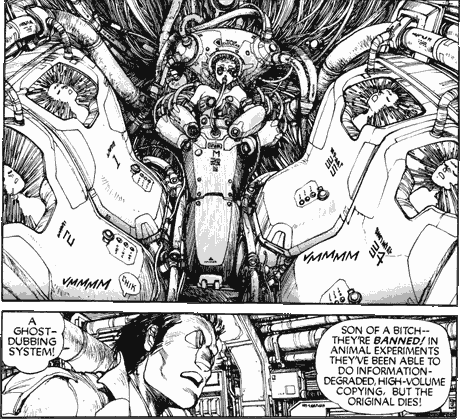
Ghost Dubbing Machine in Shirow Masamune's
Ghost In The Shell (1989-1990)

I think probably the most disappointing part of Mission to Horatius is that ultimately the 'big bads' are space Nazis, which is just lazy narrative shorthand for "look, aren't these people irredeemable and deplorable?!".  Well, that and there's not an alien in sight just fringe humans being mostly terrible to each other; which somewhat defeats the object of having alien races representing different facets of humanity, yes?

Characterization isn't very good on the whole, but perhaps would be satisfactory to younger children.  it surprises me that a capable author would get stuck on some characterization elements,  There's only so many times you need to mention that Spock looks 'satanic' for example.  Kirk's characterization is very off key and isn't really the Kirk we can really recognize from the TV show, books, or fan fiction... he's just wrong.  Whilst I accept that everything is simplified; bad characterization doesn't have to be a direct result of writing for children:  If anything characterization should be stronger in a children's novel.

A definite shortfall which blights the whole book is that it has been artificially simplified 'for children' and so made dull.  That being said adults seem to have hated it while children liked it, so what do I know, eh?

Anyway, I think it's an interesting, quick read for those interested in fiction contemporary to Star Trek being on television.  I don't think there's much merit to the book personally although the dated illustrations and language add to it's charm somewhat.  I'm glad I read it out of interest, but I'm unlikely to read it again, if you see it going for pennies, it might be worth getting, but otherwise don't worry about adding this one to your collection.

Friday, 22 September 2017

Star Trek - Crisis on Centaurus

Kirk ran it through his mind again.  We're relatively safe as long as we stay in here, as long as Burke knows where we are and feels in control.  If we leave Burke will think he's losing control, and we're dead.  But we've got to leave.  Now just how the hell are you going to pull this one off, Jim?

First question: Was this novel sponsored by American Express, Coca-Cola, Hilton, and British Airways?
Second question: Did I watch the same Star Trek as Brad Ferguson (author)?

From the outset Crisis on Centaurus (#28 Pocket, #47 Titan) (1986) by Brad Ferguson delivers a quite warped view of the Star Trek future.  I'm not going to pull any punches; the story was pedestrian, characterisation was poor, and understanding of the Star Trek almost nonexistent.

Crisis on Centaurus isn't getting a good score, that's for sure.

There were so many things simply wrong about this book, it's difficult to know where to start.

Summary of Crisis on Centaurus - Memory Beta (as of time of writing detailed but incomplete).

The Story

The story was simplistic and uninspired and hinged upon beliefs and mentalities confirmed to be eradicated by this time in human history.  We know that the concept of money is a little hazy and that we know that racism within humans is pretty much unheard of, and we also know that Alpha Centauri IV (or in this case Centaurus) is a thriving Federation colony (in fact a founding member of the United Federation of Planets).  Much of the narrative of Crisis on Centaurus hinges on Centaurus being somewhat at odds with the Federation and Federation principles so ultimately Crisis is based on a faulty premise to begin with.

Initial conflicts of interest / principles with the Federation are apparent from the first page.  What really stuck on page one was the 'American Express' cash machine.  The use of real big name brands occurs throughout the book and to me indicates not only a lack of understanding of Star Trek but also a severe lack of imagination.  I might have been able to ignore the rampant capitalism if Ferguson had bothered to invent an equivalent but... for me the inclusion of American Express (which highlighted a monetary system), Hilton, Coca-Cola, and strangely British Air(ways) broke my suspension of disbelief.

Stretching for ideas, Ferguson uses racism to try and make his villains more... villainous.  Humans who are not only xenophobic of other species, they are also white supremacists!  So, did we watch the same Star Trek or did we see two different shows?  Star Trek TOS explicitly says racism doesn't exist within humans two or three times, humans have grown past that.

Additionally, part of the plot is that the planet's defence system has gone haywire and is shooting nukes at anything that flies...  Sorry, are we part of the Federation or not?

The story is so badly structured and conceived that in order to have an understanding of the motivations of the plot the main remaining villain gives a long winded hypothetical exposition.  Look, Ferguson, if you've got to the point where you've got to wrap up a book and the only way you can do this is by having the bad guy (who really wasn't behind the big explosion anyway) tell you everything from the motivations to the execution of the events because otherwise everyone is going to be none the wiser... you've failed.

A subplot is that the Enterprises' computer system has been damaged and it might have been sabotage!  Except it wasn't and nobody really thought about it too much and took quite a cavalier attitude to the fact there might be a saboteur on the ship, in that nobody actually investigated anything.  As it turns out a tiny black hole winked in and out of existence while the Enterprise was travelling at warp two and that's what damaged the computer system.  It's not really investigated until the end.

Ferguson also seems to forget how the chains of command works on the Enterprise and makes a big thing about Uhura being put in charge of the Enterprise (presumably because she's black or something and it fits with his white supremacists plot point).

Characterisation

Characterisation was poor all round with Kirk having some terrible dialogue and out of character moments, just take a look at this example of sterling writing:
"You can't afford to sneer, Barclay," Kirk said.  "You're too close to being dead right now.  So shut that hole in your face and stay down on the floor."
 Um... What even is this dialogue?  Much of the 'character development' for Kirk revolves around that he'd much rather kill the criminals behind the atrocity but he's going to do his duty despite his desire to end their lives himself.  Laughable.

Spock gets off lightly and Ferguson puts in a few emotional lapses so he isn't a complete robot 100% of the time.  No really terrible dialogue that I can recall but nothing wonderful either.

McCoy is barely in the novel, nor is his daughter Joanna.  You'd think there would be character development here, McCoy being worried about his daughter, some exposition through his daughter.  Well Joanna makes an appearance for about 25 pages, McCoy for reasons unknown doesn't go down to the planet to help until after she is found alive.  Personally I would have thought that nothing would have stopped McCoy from going down to the planet especially since he wouldn't be going on the transporters since they are non-functional throughout the novel.

An OC nurse however does go down to the planet's surface in McCoy's stead.  Her purpose is to provide some cringe inducing dialogue from Chekov and to create some sort of tragic, abortive love affair with him.

Which reminds me every-single-woman is commented on or leched at by Kirk and/or Chekov.  Every time those lines came up I felt like shrivelling up in embarrassment.

The Villains are non-entities.  The scientist who started the blast was a bland nothing, the bad-guys Kirk was trying to save in order for them to be taken to trial and avoid the Centauran death penalty (what?) were bland, uninteresting and 'the big bad' was cliched.  The best villains were the government agents, who weren't villains at all and just wanted to arrest the terrorists under their own laws.  Kirk didn't like one of them... probably because the government official was competent and doing his job unlike everyone else in this version of Star Trek.

Basically, don't read Crisis on Centaurus.  It's a waste of time.  It's not even a good story, let alone a good Star Trek story.

1/5 - Product Placement.

Sunday, 6 August 2017

Star Trek - Shadow Lord

Mr Spock stared at the back of the prince's head as if he wished he could impress his words directly upon the prince's brain.  "As painful as life on the border may be, it is a place where change first begins for a culture; and something new and better can be created."

Bibil opened a jar and proffered it to the prince with a bow of his head.  "As your father said when he sent you on your journey, we must find a way to combine technology of the Federation with our own higher spiritual values."

Shadow Lord by Laurence Yep (#22 Pocket, Giant Novel - Titan) (1985) is not the finest example of Star Trek fiction; this is mainly because Yep has no interest in actually writing a Star Trek novel.  The result of this is a sword and sorcery novel with Star Trek characters slotted in to enable it to be sold to Pocket books.  I wouldn't be surprised if the first draft of this novel had a stoic elf sorcerer and his plucky halfling bodyguard in the place of Spock and Sulu.

And I would totally read that book.

Frustratingly, Shadow Lord is  generally well written and I did enjoy it, but if the criteria for 'well written' is 'accurately portrays Star Trek characters and their universe' then unfortunately it falls flat.


Well Jen, if you seriously enjoyed it, surely this is a success? Well no, questioning voice in my brain, it isn't.  If I want to read a sword and sorcery novel, I'll go out and read a sword and sorcery novel, I won't pick up a Star Trek book, capiche?  Also I read Star Trek novels because I like Star Trek characters so when they are completely out of character (touchy feely, smiley, comforty, Spock for example) then it kinda stops being a Star Trek novel.  I also like the Star Trek universe and the technology, and the spaceships etc. but that doesn't really feature either in Shadow Lord.  When both of these rather important aspects Star Trek are missing...then how can this be considered a Star Trek novel?

I'll make it easy for you.  It can't be.  But... an author's gotta do what an author's gotta do, right?

Shadow Lord  was not Laurence Yep's first publication.  From a brief look at his history, his earliest published work appears to have been in 1968 - although I would be surprised if there were earlier publications.  Yep is a prolific author with plays, novels, and picture books under his belt, he would write and publish very few science fiction stories ultimately (four - one children's story and three adult), he would later write predominantly fantasy novels (surprise surprise).

So essentially, great writer, wrong genre.  As testament to to his skill he manages to make a 'bad' Star Trek book not just readable, but enjoyable.  I would like to know if he actually watched the series properly or if he was involved in the fan community in any way because his image of the characters seems to be quite superficial a lot of the time and yet when we have say an argument between McCoy and Spock, it seems to be on the money.

The story itself is pretty simplistic and run of the mill and... so not anything close to Star Trek.

The premise is that a reluctant prince from a world which technologically is stuck around the seventeenth century and socially... well I'd say they were medieval, is returning home in order to influence his planet's modernisation under the guidance of the Federation.  However, when he returns to his home planet he finds that the unguided modernisation his father has begun has caused great suffering and poverty and a coup takes place.  The prince escapes with the help of Sulu, Spock and some loyal retainers and makes his way to his family's land in order to drum up support.  On the way he sees the horrors of his world and decides that although he'd rather stay on the developed worlds of the Federation he must help his people.  The prince gets support from his people, fights a battle where his people win because they have guns and the 'bad guys' army have plate armour and swords.  The prince wins a duel using a technique Sulu showed him at the beginning of the novel, and the prince becomes emperor.  The Enterprise returns to pick up its two officers and leaves some of its other crew to help with the modernisation process.

The story isn't new, it isn't anything ground breaking, it certainly isn't inspiring.   It's pretty much a stock fantasy story sandwiched between two 'Enterprise' sections.  It's a stretch to involve the Federation at all at this point however, I mean they shouldn't be messing with the development of 'undeveloped' worlds in the first place.  Of course this modernisation is going to cause fear and resentment in the people of the planet, they're barely able to get their heads around the fact aliens exist and when they do the result is xenophobia.  I think this is reasonable when you've got an unfathomably big organisation which is unfathomably more developed trying to influence your medieval planet where the height of diplomacy is sticking someone with a sword!

The characterisation, like I mentioned before, can be both strong and weak.  The original characters are better characterised than the established Star Trek characters.

Sulu

Sulu is probably the most natural choice for this story as a representative of the Enterprise / Federation especially when you're beaming down to a planet where the people live and die by the sword (because of the revelation that he enjoys fencing in the episode 'Naked Time').  Personally, when I saw it was a novel where Sulu was going to shine I almost put it down in disappointment.  I generally dislike the characterisation of Sulu and I don't particularly like George Takei. However, Yep's characterisation is so off the mark that it makes Sulu palatable, probably the first time I've actually praised a bad characterisation.


The reason I wondered if Laurence Yep was involved in the fan community is because his characterisation of Sulu is incredibly 'fannish'.  There's like this mythos around Sulu that he's this sword fighting fanatic with a massive obsession with outdated militaria.  It's beyond that he's an expert, it's highly romanticised.  Most of the time this is emphasized and as a result his science capability and his interest in exotic flora is forgotten.  Despite this 'fannish' interpretation, Yep produces a palatable Sulu and made the book readable for me - thank you OOC Sulu!

Spock

Spock is probably the most out of character of the lot, it's not that he's too emotional, it's that he does things that he simply wouldn't do.  Comforting someone by grasping their shoulder for example, openly smiling.  His major contribution to the novel is to bridge the gap between the prince and his duty.  Spock is used as a 'child of two worlds' and is a parallel to the prince who feels the same way, having essentially grown up in the Federation.  After reading a little about Laurence Yep, I realised that Spock (and the prince as well, really) was probably interesting to him as a vehicle to explore his own feelings as a 'child of two worlds'.  Spock manages to be removed from the action when he takes a spear to the hip (better than an arrow to the knee I suppose), but the situation seems quite forced.  I'm not sure why he needed to be removed from the action, unless Yep really likes Sulu? It's not like Spock was overpowered or anything in this story, if anything he was underpowered.

Original Characters

Yep's original characters are probably the strongest (they're the ones he actually wanted to write after all).  The prince (Vikram) is initially foppish (although this is mainly an act) but proves that he's actually worthy of running a planet and reforming it.  The character's development isn't much of a surprise as it's all pretty telegraphed including his budding relationship with Urmi, an initially untrustworthy character who learns to love the prince after travelling with him and helping him get to his family's land.  It just so happened to be that she was his guardian's (?) niece.

Vikram's guardian, Bibil, was a likeable character who had a heroic rat beetle related death and was characterised well.  Actually, most of the minor characters were characterised nicely, even if they are introduced for only a couple of pages which I think is testament to Yep's ability as a writer.  The one character where I'd say it falls down is the villain of the story 'Lord Rahu', he's a bit of a non entity whose actual motivations aren't really fully realised.  A proxy for Lord Rahu is used much of the time, so although we sympathise with the proxy (a good man, doing the right thing for the wrong reasons) and get to know him, we don't really learn about Rahu.  Rahu never really achieves the magnitude he needs to be truly effective.

Finally...

Shadow Lord is an enjoyable story if you're not really expecting to be reading a Star Trek novel.  It doesn't really add any understanding to the characters, nor does it offer a particularly inspiring sci-fi / Star Trek scenario.  It's hard for me to say 'don't read it' because despite its many flaws I found it enjoyable, on the other hand it's not really a successful Trek novel and I don't think you're missing o out on a dose of Trek if you don't bother with this one.

1/5 - Sorry!

Sunday, 9 July 2017

Star Trek - My Enemy, My Ally

"Yes," she said absently, "it would have been a shame to blow up Enterprise too.  The workmanship appears excellent."  She flashed a smile at him: Jim became aware he was being teased.  "Captain, I come to you because I see my world in danger - and incidentally yours - and there's no more help to be found among my friends.  At such a time, with millions and billions of lives riding on what is done, pride dies, and one has recourse to one's enemies.  Of all my enemies I esteem you highest..."

Well... what can I say that hasn't been said before? Diane Duane has produced a superb book again, this time in the form of a high stakes adventure involving the Romulan Empire in My Enemy, My Ally (1984) (#18 Pocket, #21 Titan).
I've used one of the new covers this
time.  It's not so different and it shows
the artwork off nicely :)

My Enemy, My Ally is quite frankly a phenomenal read and it is of little surprise that Duane should spawn a mini series from this book.  The Rihannsu Saga is a five book series written between 1984 and 2006 and has left fans demanding that it should be made canon.

I've previously reviewed The Wounded Sky and Doctors Orders by Diane Duane, if you're interested, go check them out!

When I talked about The Wounded Sky I waxed lyrical about the necessity of entropy and how the book was literally falling apart while I was reading it.  Well, the condition of this first edition copy of My Enemy, My Ally is only slightly better.  It's obviously well read, its spine utterly broken and the pages threatening to fall out... though it hasn't disgraced itself quite yet.

Now, a confession.  When I first tried to read My Enemy, My Ally  a couple of months ago, I wasn't in the mood for it.  I ended up selecting a much shorter, snappier novel that suited my mood better.  I'm really glad I didn't try to push through it when I wasn't in the right frame of mind, because I wouldn't have enjoyed it half as much!  My Enemy, My Ally isn't a light read, there's a lot of backstory to set up, new characters, a political situation and indeed, much of Duane's version the Romulan culture.  What is nice is that in the forward Duane pays homage to D C Fontana, and says that she has tried to use much of Fontana's vision of the Romulans and Vulcans, as Fontana was heavily involved in their creation.

My Enemy, My Ally documents an unusual alliance between the crew of the Romulan vessel Bloodwing and the crews of the Federation's Enterprise, Intrepid (II), Constellation, and Inaieu as they try to prevent the permanent (and detrimental) alteration of the Romulan species and then the rescue of over four hundred of Intrepid's Vulcan crew - just in case the stakes weren't great enough.

At the centre of all this is an original character -Ael- who is a distinguished Romulan Commander who also happens to be the aunt of the Romulan commander Spock and Kirk had a hand in disgracing in The Enterprise Incident, an event which comes back to haunt both Ael's loyal Romulans and the crew of the Enterprise late in the novel.


In My Enemy, My Ally, Duane has fixed I think many of the complaints people had of The Wounded Sky, namely the pages of techno babble that some have found confusing or boring (personally I like it, but hey) and instead keeps it to a more palatable level.  In its place she adds in swathes of Romulan (or Rihannsu) language which reminds me strongly of Tolkein's high elven (which is a mix of Finnish and Welsh language), and extensive exposition of their society, culture and beliefs.  I think the language is a bit of a mixed bag, as it both adds and takes away from the narrative a little bit.  For example, we often are privy to conversations solely in Romulan, but why would it be there without translation when we are observing through Ael's eyes and her thoughts we are able to understand.  On the other hand the language difference is effective when dealing with new concepts which are not easily translated.  At some points a word which represents a broad concept is explained and then it is used frequently in the text in its original form.

Duane's development of the Romulans is in depth but interestingly not too removed from Ford's ideas about the Klingons in The Final Reflection.  Duane's Romulans are also scheming and aggressive although not so overtly savage as they wear a veneer of civilisation.  The Romulan savagery comes from their complex, tiered society and their political games.  Whereas Ford's Klingons affirmed that with determination, guile and luck that even a nameless orphan could rise through the ranks and make a great commander, in Duane's society there is clear demarcation of the 'haves' and the 'have-nots'; the Romulans have a rigid class system.

Another crossover between Ford's Klingons and Duane's Romulans is that they both have a fixation on 'names' and 'houses'.  However, Ford's Klingons seem to be able to create their own lineages (albeit with some restrictions) whereas Duane's Romulans appear to to lose all status if their names are removed from them and don't appear to be able to create a new name to try and rise again.

Duane's Ael is also used to introduce an element of spirituality to the Romulans, although her beliefs seem a little out dated as they are not referred to by any other Romulan we encounter without prompting from Ael herself.  The Romulans seem to have the belief in opposing and complementary elements; basically something like Taoism.  Ael uses this belief system to understand those around her, and attributes various elements to characters like, for example, Kirk, Spock, and McCoy to explain what their roles are and why they work as a team.  Ael's reflections actually give some really nice exposition on the characters we know and love, but also has a narrative function in that it's these observations which allows Ael to accept the differences and similarities between the Romulans and the Federation crew.

And really, like Krenn in The Final Reflection her ability to break from the mental mold of her people and find kinship with people from the Federation is also what eventually isolates her from her people and even face betrayal from members of her own family.

However it is because she is so loyal to her people that she doesn't wish them to change themselves to make themselves more like the Vulcans, she sees that this would not only destroy their culture but also cause them to destroy themselves because of the way their culture and society has developed.  In saving them, Ael faces permanent isolation from the people she loves so much with only her much depleted loyal crew as company and support.  It's testament to her ability as a commander that so many of her crew do stay loyal to her despite the fact they will be pariahs.

It's really hard to pick out a part of My Enemy, My Ally that could be considered 'best', but I certainly enjoyed reading about the developing relationships between the Enterprise crew and Ael's Romulan crew.  I really enjoyed the recurrence of  characters first seen in The Wounded Sky, like Harb, and the Sulemid crew members.  Duane also includes a Horta in her mixed crew!  I really do like how she includes so many different species on the Enterprise crew and elsewhere in her novels!  Of course, one of the most moving aspects of this is the message that with exposure, even the most xenophobic people can become friends and allies of 'the other'.  This is exactly what happens to the Romulans when they mix with the diverse crew of the Enterprise.

The relationship between Kirk and Ael builds up slowly between the two captains and by the end of the book, they trust each other completely.  It begins with a grudging respect of a talented commander, and progresses slowly to an unshakable trust based on a true assessment of each others character.  Knowing Kirk well, we understand the trust he has to place in Ael in order to put his crew and ship in danger, Ael's thought process is, by necessity more exposed by the narrative.  She gradually makes her assessments, she sees that Kirk is of the element of fire (like herself) and that his crew (especially Spock and McCoy) balance him out.  A funny little observation is that Ael sees the three of them moving as one, as if one entity - essentially, all the elements together.  I suppose I should point out that the relationship between Ael and Kirk is platonic, Ael herself is Romulan and has a grown up son (who is her second in command), and does show her age somewhat, though Kirk is left to speculating how old she truly is.

My Enemy, My Ally is set between Star Trek TMP and TWOK (about 2275) which I think is a really interesting time to set a novel,  as you have all that character development from TMP especially between Kirk and Spock but also because he is a seasoned commander and the Enterprise is pretty much an icon of the Federation.  One confusing thing however (and perhaps I'm missing a trick) is that uniform wise we appear to be in the TOS era, while Kirk seems to be going by the title of captain despite being an admiral at this point?

Ah while I think about it, there was another funny inconsistency (?) I noticed, well my partner did (despite the fact I play World of Warships and it should have been apparent), was that Duane calls the Inaieu a 'destroyer'...  Destroyers are little ships, I think what she really meant was 'dreadnought!'.  Oops!

Anyway, I guess I'm nitpicking, because I've gotta make a point - those few thing are literally all I've got to complain about!  Everything is just so tight!

Something I seriously can't complain about is Duane's ability to write interesting hand to hand fight and space battle scenes! Kirk of course has to get stuck in with an incredibly large assault group and manages to get injured - thankfully he gets off light this time!  Bless him, that little cinnamon roll!  Duane just makes the fight scenes flow, she can write tension but she knows when to break the tension with humour too.  She also throws the eye of the reader around a little, she doesn't just concentrate on one perspective of the fight but updates us on how other crew members are doing.  I particularly like her updates on her OC crew members, who supply some variation to the fights!

Duane's space battle scenes which of course I can't talk too much about without giving away the story, were just fantastic as usual.  It got very tense close to the end when Kirk is not in the captain's chair, I tell you!  However, it was rather gratifying to note that Kirk 'called it' at the end!

I'll leave you now with one exchange that made me spit out my tea when I read it!

"All right," he said.  "I consider myself warned.  But if you two are going to play 'mother hen,' don't either of you be surprised if you find me holding your hand."
"Fine by me," McCoy said.  "But watch it with Spock.  People start the damndest rumors about this ship's crew, even without provocation...."
"Doctor, how does one hold hands with a mother hen?" Spock asked innocently. 
"Gentlemen!!"
Ael kept her laughter to herself.


 Well, someone certainly has read the Roddenberry Footnote!

5/5  - Just read it, it's a no brainer.

Thursday, 8 June 2017

Star Trek - The Trellisane Confrontation

Kirk had been staring into space, not lost in thought, but helpless and hopeless, stunned by the loss of his ship.  He had never felt quite so abandoned, so lost, his very foundation removed.  McCoy leaned toward him and said softly, "Jim.  Captain Kirk!"

I have to say I was elated on reading The Trellisane Confrontation by David Dvorkin (1984) (#14 Pocket, #31 Titan), after all I was bracing myself for a literary blooper after having three excellent books on the trot.  After the hit and miss approach to the first ten books in the series, I have to admit I was getting a little downhearted at the prospect of having to suffer more of the same in books #11 to #20.  Honestly, it's like they turned a corner at Web of the Romulans, hopefully they don't look back?

That isn't to say The Trellisane Confrontation doesn't have problems, it does... a surprising amount in fact considering how short it is but it does have more of a feeling of an episode than the previous three books, which felt like they could never really be episodes (I acknowledge The Wounded Sky was adapted to a certain extent for an episode in TNG).

Okok, note on the cover.  Accurate uniform on Spock, this novel takes place in 2269, so during the original five year mission.  I actually like this cover a lot, it's colourful, it's fun... it's... who is that woman in the middle?  I was waiting for a damsel to appear but uhm... she doesn't?  I had a thought that it was supposed to be Chapel, but then why not put her in uniform, and I don't really think she fits the description of the warrior women of Nactern either, other than those mentioned and other than Uhura (who it most definitely isn't) there aren't any other female characters?

Edit:  Ok, people seem to think it's Christine Chapel...  I'll believe them, I suppose Spock looks facially squiffy too...

The Trellisane Confrontation follows a quite a simple plot.  The Enterprise is transporting dangerous criminals who are affiliated to a political faction who wish the Federation to go to war with the Romulans.  Whilst transporting them, Kirk decides to go to the aid of a peaceful, neutral, planet being attacked by it's aggressive sister planet in a system in a precarious position between the three powers (Federation, Klingon Empire, Romulan Star Empire).  Spock and McCoy express their reservations about going to aid this planet with dangerous prisoners on board, but Kirk is adamant and proceeds without confirmation from Starfleet.

Naturally, everything goes wrong.  The prisoners on the Enterprise escape and gain control of the ship in order to try to start a war with the Romulans while Kirk, Spock and McCoy are on Trellisane.  The Trellisane people are not the peaceful progressive people they appear to be, the attacking Sealons and Klingons step up their invasion plans, and Spock and Kirk are captured by the Klingon and Sealon forces, leaving McCoy to organise a the Trellisane people and uncover their dark secrets.

That's the set up for The Trellisane Confrontation, and although a little simplistic at times the first half is a pretty strong and enjoyable read.  The pacing is good, it doesn't sweat the small stuff and expects the reader to fill in some gaps.  However, in the second half of the novel Dvorkin appears to lose impetus and aside from a very interesting section with Christine Chapel melding with an alien it doesn't have many other high points, in fact I became quite irritable about some inconsistencies I couldn't un-see!  The novel resolves itself a little too quickly not allowing Dvorkin to really get the meat (ha) of his story.  We get a need to know exposition via McCoy of the Trellisane culture, a rather pathetic bunch who are essentially cowards and cannibals.  The Sealons, the species being manipulated by the Klingons turn out to be a bit on the rough side but rather more likeable than the Trellisane people, despite never hearing a word directly out of their mouths.  The political situation gets resolved in a couple of pages... and Klingons and Romulans beam straight onto the bridge for discussions?

My main complaint however is what I can only suggest are strange, loose, narrative threads that by the end of The Trellisane Confrontation are not resolved.  The odd moralising at the end which attempts to give an illusion of tying those threads but really just leaves them broken.  This is really shame because it really does spoil the book, in my estimation, after a well paced and pleasant first half.

Here's an example; Spock notices behaviour he doesn't like in Kirk, and this rattles him and his confidence in Kirk.  Personally I didn't see a problem or out of the ordinary behaviour, but I ran with it.  I spent from that time onwards waiting for some sort of revelation that something was wrong with Kirk, like, there's something in the air on Trellisane, or there was something in that delicious delicious meat her ate... but it's nothing.  It turns out that Spock hero-worships Kirk and just hadn't seen this aspect of him before...  We are in the same year as The City on the Edge of Forever guys...  you know each other quite well at this point!
Spock followed him, and as Kirk leaned over to offer him a hand to help, Spock was amazed to see that his captain's face wore a broad grin.  It was something beyond simple levity or the release of long suppressed tension, Spock thought; it seemed more the joy of a young boy on a long-awaited long-delayed holiday.
(...)
Now, suddenly, the control seemed to have disappeared.  In this earnest, deadly business, James Kirk was behaving with boyish glee rather than the calm determination Spock night have expected.  Kirk was dropping to the level of the average human, and Spock, who would have been greatly insulted had anyone suggested to him that he was capable of hero worship, was deeply disturbed. 
 This actually connects with analysis of the criminal who takes control of the Enterprise.  In several sections the criminal (Hander) is likened to Kirk and in a final exchange with Spock and McCoy, they underscore their similarities.  Now, I might be a Kirk devotee, but I think this is a bit of a stretch and Spock and McCoy's final condemnation? criticism? of Kirk's character and actions during the events of the novel was quite inaccurate and very unfair.  Kirk was right to be angry about what they were saying!

The slave/cannibal aspect of the Trellisanians was interesting, especially when reflected by McCoy.  I particularly liked the 'not all as things appear theme' which was prevalent, and probably does the best job at holding the story together.

The subplot (?) on the Enterprise where Hander Morl and his five alien allies take control of the bridge was actually pretty enjoyable, and I especially relished my least favourite character Sulu being the one to cock up utterly and cause the whole situation.  Chekov's scenes were excellent, and his trying to emulate Kirk was wonderfully written and very funny.  Uhura was very much in the background but what did surprise me was as mentioned before, Chapel's section.  I think that was very well done although ultimately she doesn't reveal her experiences.

Ultimately, The Trellisane Confrontation is an enjoyable book and well worth a read.  It doesn't reach the heights of The Wounded Sky or the tension of Mutiny on the Enterprise, this book is smaller in scope and less detailed than the previous couple of novels.  Characters are a little out of character at times, although Dvorkin seems to be better at characterising the likes of Sulu and Chekov than Spock and Kirk.  Action is a little disjointed and at times frustratingly sparse on details, but not necessarily bad.  I don't think The Trellisane Confrontation adds anything to the existing characters, Dvorkin does create an interesting culture in the Trellisane species.

3/5 - don't order the steak.

Monday, 5 June 2017

Star Trek - The Wounded Sky

Breathe, damn you!  Breathe!  Breathe!
It was his worst nightmare come true.  He damned for the thousandth time the idiot courage that let this man throw himself among wild beasts and into blaster crossfire for his crew's sake.

There must be some sort of irony in the fact that, whilst reading a book which at its core espouses the beauty and necessity of entropy, that I spent quite some time trying to save the book itself  from entropy.

I find, with used books it's often a good sign when the book is so well worn that the glue holding the pages together has failed.  Annoying as it is to have to keep picking up and carefully reinserting the pages, it means, often, that the book has been well read and loved - such as it is for my copy of The Wounded Sky (1983) by Diane Duane (#13 Pocket, #19 Titan).

My copy of The Wounded Sky is currently held together with a lot of tape; fifteen pages have been stuck in with care by my hand, and they will probably now hold together long after the two hundred and forty other pages have given in to the fate of badly produced mass market paperbacks.  The wear on the book was not a result of my eager thumbing of the pages, but of its previous owner, whoever he was.

I assume it was a he.

I also assume he is dead.

You see, this and about eighty other Star Trek TOS novels I imported from the states some months ago.  They are mostly Pocket Book first editions, with gold or silver embossed titles, they were collected over a number of years and they all have the same little label on them with the price and the code the shop has given them - the same shop.  Most of them are in good condition, they have been stored on a shelf and at some point a book worm (or whatever a book worm really is) had eaten holes into some of them.  I found a shed 'shell' from one of them, and I was a little worried that I had imported infected books and I would be solely responsible for introducing some terrible book eating insect to the UK ecosystem (I haven't by the way...).  The books were slightly damp, musty and dusty like they'd been in storage for a good while.

In my head canon, the daughters of the dead man were getting rid of his possessions.

I bought over eighty books, eighty of this man's collection that he had dutifully maintained, buying every book as they came out for years and years, for about $24.  It cost me less to buy them in the states and import them with all the charges and shipping fees than it would be to get them from my own country.  It's a little sad isn't it, for someone's collection to be sold by someone else for virtually nothing.  Even sadder that the people selling it had no idea that just one of the books was worth me paying all that.

Out of all those dutifully bought, kept and loved, 'The Wounded Sky' is the most read.

On the first page of The Wounded Sky there are two recommendations from other authors. "AN EXCELLENT STAR TREK NOVEL (...) ALWAYS ENTERTAINING" espouses one enthusiastically.  Another writes "IS A REMARKABLE NOVEL IN ANY CATEGORY AND BEYOND A DOUBT THE BEST STAR TREK NOVEL EVER WRITTEN" not insignificant praise for a 'media tie in', but accurate.

Hum... looks like TOS style uniforms...
The Wounded Sky is set in 2275...
Between  TMP and TWOK.
Lots of people review Star Trek books with a proviso, 'Yes, I give this book 5/5, it's good for a Star Trek book' and I also review on that kind of scale.  This book however could easily stand on its own, it's not simply good for a Star Trek book, it's a good book and I think able to comfortably  be compared with other non tie-in  novels of the time.  Essentially what I'm saying is that The Wounded Sky doesn't rely on being a Star Trek book to succeed, it doesn't need Kirk, Spock or McCoy or The Enterprise, but for a fan of Star Trek it just makes it sweeter and Duane's effortless characterisation of our favourite characters is the cherry on the proverbial cake.

The Wounded Sky is Duane's first published Star Trek novel, she also had another published in 1983 -  the first in her 'Young Wizards' series.  I have read and reviewed another one of Duane's Star Trek novels Doctor's Orders, you can definitely see Duane reworking ideas from The Wounded Sky in her later novel (certain aliens reappear with different names, aliens with a different concept of time etc.)!

I have to confess I thought on looking at the cover (so deceptive, as usual) that the jellyfish thing was going to be the 'enemy'.  I remember thinking well jellyfish are disgusting so obviously they make the best villains, well I'll put this right first of all - the jellyfish on the front isn't a jelly fish at all, but a glass spider with twelve legs!  She also isn't the villain but simply the cutest glass spider you ever did lay your mind's eye on!  More on K't'l'k later (she's so stinking cute).

I think it would do this novel a disservice to write a 'summary' as I do for others.  In fact I'm not sure that with only one reading of the novel behind me I can do an adequate one.  The Wounded Sky is complex and Duane draws in many narrative threads which she weaves in at various points in the novel.  Despite having so many different threads Duane has managed to create a very cohesive story, and it merits another read from myself to try and get my head around why it's so bloody brilliant.  Me reading it out loud even made my partner want to read it!  He liked Duane's easy turn of phrase and strong characterisation, but he particularly liked Duane's scientific knowledge as he reads quite hard sci-fi and he commented that she must have been keeping up with contemporary scientific papers.

It is easier to talk about themes rather than story, so I'm going to talk a little about them.

God, Religious Experience and the Soul

I was probably most surprised at this theme turning up.  K't'lk introduces talk of the soul when talking about the beliefs and rituals of her people but the entire last section of the book questions the idea of what God is, what heaven would be like and the shape and the transformation of the self / soul into it's best form.

The crew are exposed to beings of such power that they are essentially described as proto-gods, and in fact, they will be gods in their own universe creating and experiencing as they will it or until they stop playing the game. The playing the game theme crops up throughout the novel especially through an original character the 'recreation officer'.  I'm not sure whether it has more significance generally, but within the novel itself it is pretty important and well built upon.

It is implied that the crew all experience a religious experience on approaching the proto-gods.  It's heavily implied that a place without entropy is tantamount to heaven (and the transformation of the Enterprise crew supports that).  However, the crew perhaps recognise that their experience isn't 'heaven' and they don't belong there, they have a sense of purpose and they give that purpose to the proto-gods.  These supremely powerful beings did not create this universe, but have the power to create and play in theirs - however, this still requires the input and interruption of the crew to bring about.  Perhaps God of this universe (or at least the Star Trek one) is still working on creating, and through His vessels having a hand in creating another?

The Best Self


This theme is woven throughout The Wounded Sky and for those of us who enjoy character exposition and development the last section of the book will reap the biggest rewards.  Even if you're put off by the the harder science sections, stay with the book to the end, it will be worth it!

'The Best Self' idea is tightly linked to the 'God / Religious Experience' theme.  For someone with a Christian background the imagery is very familiar and the transformation the crew go through with their selves being transformed into a reflection of the greatest good, devoid of 'entropy'.  This section is from Kirk's perspective (though the idea of perspective is skewed here anyway), and through his eyes he sees his friends and crew utterly changed into their best selves.  Naturally, Kirk never truly perceives or realises the change in himself and in fact, we only get one comment from McCoy that indicates Kirk's own physical transformation.  Duane pin's down McCoy's compassion and healing, searing in its strength and passion.  She nails Spock's dual nature, the power of his mind and potential to be great.  Kirk feels awed that someone such as Spock, with so much ability and brilliance should choose to serve under him -

This great mind has been standing behind me and quietly obeying my orders all these years?  Why??  He could be so much more - But in this place, the answer was plain to read.  Loyalty was frequently unreasonable and illogical - and Spock had long since decided that this one aspect of his life could do without logic.
"Spock,"  Jim said - and ran out of words.  He was deeply moved, and didn't know how to express it - until he abruptly felt Spock feeling the emotion with him, and knew there was nothing more that needed saying on the subject.  "I'm fine, Spock," he said then, and glanced over at McCoy.  Bones was gazing at Spock in a curious, almost grudging calm.
Seriously, how powerful is that?

Much of our exposition of Kirk is done through the other character's reaction to him and his reaction to their transformed selves.  Kirk describes his role for much of the telepathic experience as 'passive', he is moved by the fact these 400 souls follow him while feeling unworthy himself.  In his own estimate, he sees himself as a conduit that can focus the abilities of his crew, this is demonstrated through his 'weaponising' of Chekov and Scotty's emotions and beliefs.  While the crew is being transformed or being followed by strange manifestations of themselves and their desires, Kirk comments -
 Hidden natures are getting loose, Jim thought.  What we conceal doesn't stay that way, here.
So, what is McCoy's observation -
 "- That armour getting heavy?"  Bones said, sounding a bit tentative now.  Jim shook his head, thinking What armour, what's he seeing? ... 
That is literally all we get as to Kirk's transformation - how frustrating!  Kirk's character is left open to debate, but it certainly isn't just a conduit as he believes it to be.  Certainly, we know from other characters and our own knowledge that he inspires fierce loyalty and trust, and that he himself is self sacrificing (as demonstrated earlier in the novel during an event which renders him without a pulse for some time).

Of course, we don't just learn about the transformation of the 'main' cast.  Several other crew members have extreme transformations... one which sticks out is the crew member who transforms into a six legged Andorian alicorn...

The best self theme isn't just limited to this one section however.  During various experiences using the inversion drive we see the crew acting in ways which hints at their best selves.  Uhura, Chekov, Sulu and some new characters introduced in this book (original characters done right!) all get their chance to shine and have their own exposition.   The way Duane uses this theme to bind the book together keeps you turning pages, thirsty for more character exposition!

Sex and Relationships

Initially I thought that this theme was surprising to find slotted in to a section in this book, but the more I thought about it, the more it made sense in context especially taking into account the Christian imagery and tone in some sections of the book.

There's a very special scene slotted in around the middle of the book which is all kinds of awkward,
sweet and serious. The glass spider K't'lk and Kirk sit together in Kirk's cabin talking, K't'lk makes reference to Kirk's ah, let's say sexual encounters in this cabin.  This being commented by anyone, let alone by a twelve legged glass spider would make anyone choke on their drink, Kirk is not an exception to the rule.  K't'lk then tells Kirk about how her species reproduces, how their courtships are long and the pairs build up each other and their lives together (her last courtship was one hundred years) until it meets it's crescendo and they copulate.  The downside to this is that the female eats the male in true spider fashion, adding his DNA and 'soul' to hers.  When she creates the egg, that is the new vessel for both his and her spirits, a mixture of both.

This is of course in contrast to Kirk's passions that K't'lk refers to, but more akin to the relationship that Spock and Kirk have.  You don't need sex to be lovers is essentially the message, and K't'l'k's regret of consummating the relationship is palatable, after all it ended hers irrevocably.  The same could be said for Kirk's conquests, sex or some sort of physical interaction is the  goal after which the relationship ends.  Of course in Kirk's case, the breaking of the relationship is not necessarily as a result of sex or physical interaction of some description, circumstances dictate Kirk's commitments.  However in K't'lk's case the although reproduction is the end goal, they also have the goal of building each other up, very little of that happens in Kirk's relationships.

Weight of responsibility

Kirk and K't'lk are both burdened with great responsibility.  Kirk for his ship and crew's lives and K't'l'k responsibility for her part in the creation of the universe / reality breaking inversion drive.  I think that although she has more affinity for Scotty and his engineering prowess she is most like Kirk.  Kirk must make decisions for his crew, he feels the weight of command and often feels overwhelmed.  K't'lk also feels the weight of responsibility, however she is sure of herself and of what her course of action must be.  Admittedly, she has 800+ years of life and 3 rebirths (at least) to enable her to act with the self assurance she does.

This is a theme that is visited frequently in the original series and in the novels, in fact it is fundamental to the development of Kirk's character and is core to the original films too.

The Importance of Command

This is a bit of a funny one (funny strange not funny haha), and seems a little bit specific for a 'theme' but a large section of the book is dedicated to command, and not just Kirk's but other characters too.  During the last section of the book, the entire crew of the Enterprise is involved but in order to keep them together and moving onward, the section heads mingle among their charges, which gives the rest of the crew the strength to continue.

Of course, this ties in with the theme of the best self, especially when talking about Kirk whose raison d'etre is to command.  Kirk doesn't just hold together a section, but the whole ship.  However, as explained previously, Kirk doesn't see his talent and ability for what it is, modestly only as a conduit or a gun to shoot the bullet.

Best Scene?

Picking out a best scene is actually pretty hard since there are just so many excellent bits to The Wounded Sky.  I'll settle for two.

Would you look at that - I can use this picture again.
Probably the most memorable scene (for me at least) was where you rejoin the action from McCoy's point of view after Kirk has selflessly thrown himself in front of Spock to save him.  Excellent characterisation of McCoy just makes the scene, it's also essential.  I've discussed how we get very little in the way of revelation from Kirk himself, about himself, so we have to rely on other narrators to give us a little insight.  McCoy of course gives us insight into Kirk's character here.  There's obviously a good amount of insight into McCoy too.  The extension of the scene involves Uhura's memories (which involves her being totally badass) and Kirk coming to in his command chair injured, and realising that the unreal shared visions that the crew had been sharing are in fact as real as their every day reality.  I have to admit, I love that the drama is mixed in with plenty of humour.

The second scene I can't go too much into, but it's near the end of the book when all the crew is being transformed into their 'best selves', the imagery is pretty intense and I loved Duane's creativity mixed in with more traditional imagery.  The character exposition was really varied and just... excellent.  You might have noticed I'm a character-centric person.... You'll know the scene when you get to it.

If you've stayed with me this long - congratulations!  This novel certainly warrants more than I've written about here... Perhaps I'll come back to it later...

You're probably wondering why I told you that story at the beginning, well... Entropy is central to this novel, without entropy our universe would have ceased to exist, ceased to be and ourselves, the crew of the Enterprise and the universe as they knew it would be driven mad and suffer without it, we perceive time after all, that's how we organise our world, how we define our lives.  How can we possibly comprehend all time happening simultaneously - we can't, after all, the book itself progresses the story as if time is passing.  Things happen sequentially, in page after page while the universe around Kirk and his crew begins to slow down and speed up all at once.  Happily, Duane gives the crew a kind of protection from this although it  obviously isn't total protection from all effects of the anti-entropic space.

Thing is, somebody died thousands of miles away in a country I've never been to.  Entropy took it's course, old age or illness, time passed and his books were sold and in a sequence of events, his books got to me.  Those books with their worm holes and falling out pages tell a story far different from the story between their pages.  McCoy asks if they could spare the new gods knowledge of illness and death, and K't'lk responds:
"One thing.  When you write your equations - do you have to give Them death?"
The brilliance was dimmed.  So was that in K't'lk's eyes - their blue belonged, for the moment, more to twilight than to noon.  "L'nrd," she said in somber notes, "you said it yourself.  Time is what They need.  They can't have that without entropy too.  And death will inevitably come along with that - rundowns, breakdowns -"
Entropy is part of time and through time we experience the world, because a man died in America, a girl in the UK can read the books he collected and read, time and entropy made an impossible connection happen.

And that's one hell of a story.

5/5 - Always be yourself, unless you can be Kirk... Then be Kirk.

p.s. I am super late with this post!  I had various things crop up, I went away, was ill, became a greater number, lots of things. I was hoping to get this in at the end of May but obviously that didn't happen!  Back to regular programming now!

Tuesday, 2 May 2017

Star Trek - The Wrath of Khan - Novelisation

"Jim," he said, "I have been, and will be, your friend.  I am grateful for that.  Live long, and prosper...."

His long fingers clenched into seared claws; the agony of the assault of radiation overcame him.  He fell.

"Spock!" Jim cried.  He pounded the glass with his fists.  "Oh, God no...!"

McCoy tried to make him leave.  Jim snarled and thrust him violently away.  He hunched against the window, his mind crying denial and disbelief.

I find it singularly incredible that an author could be given a gift - a gift - of an adaptation to write, and still manage to faff it up with her own bias and preferences.

It's actually a remarkable skill, to cock up writing one of the most powerful scenes in cinema.

Good ol' Vonda has that skill though.  Not only can she manage to make Spock's iconic death scene a spectacle of mediocrity she also manages to, once again make the mind numbing decision to give more thought and reflection to an 'original character' of sorts, and skip merrily past any in depth consideration of you know, an insignificant character like Admiral James T Kirk.

I swear, Star Trek - The Wrath of Khan by Vonda McIntyre could be renamed Star Trek - Biography of Lt. Saavik because that's what it is.

If you've followed my blog before, you'll know I have a particular antipathy towards a particular author (no prizes for guessing it's Vonda McIntyre), and it's not without good reason!  I swear it!

Here read my other reviews, I'll wait.


Put it this way, I knew what to expect and she didn't surprise me one iota.  I mean, if there's information you didn't need or want to know, Vonda will provide.  If there's a female sub character / original character she can give more pages than necessary, she'll do it.  If she can somehow give more page time to Sulu, he'll get it and, frankly, she hates Scotty.  She adores Spock though, so I guess the depressingly badly written death scene might have been a little unexpected... but then again, shorter death scene means more time to lavish on Lt. Saavik.

Well at least after this book I only have, what, three more Vonda-cides to go?

I guess I better start at the beginning?

I don't know what your feelings are on books and film adaptations and where you draw the line between canon and not, but I think they need to be taken on a case by case basis.  For example, the previous film novelisation I would call canon, it was written by Gene Roddenberry after all and I feel he added significant insight with the novelisation, the novelisation actually makes the film make sense, fills in the gaps;  I reviewed it here.

This adaptation... I'd say should be in the category of don't touch it even with a stick, there's so much utter rubbish inserted, so many liberties taken I just can't accept it.  I mean, I know I don't like Vonda's writing style in the first place and have very little patience for her generally, but come on!  If you're going to write a film novelisation at least leave your bias at the door!

Lots of people have positively reviewed this ST:TWOK novelisation and said that it 'explains it all' and that they 'didn't enjoy TWOK because they didn't understand it and this fills in all the gaps'... no, it doesn't it makes up page count with utter trash filler that, if you've read a couple of McIntyre's ST novels you know it is just self indulgence on her part.

What kind of trash filler you ask?

I don't need to know that two of the scientists on Carol and David Marcus' team are jokers with a thing for Lewis Carol.  I don't need a whole poem by Lewis Carol reproduced for me to read.  I don't need to know that these two genius scientists make games in their spare time and leave that as data for Khan and co to pick up instead of the genesis project information.  Why did you have me read pages of utter rubbish about nothing characters that are shortly going to die?

Is Scotty really a prissy, thin skinned uncle?  Do we really need to know that his nephew has a crush on Saavik and has maths lessons with her?  Do we really need that painfully written scene with Spock trying to explain a 'crush' to Saavik?  Or that Saavik really doesn't like omelette because it's bland and has to use chilli on it to make it palatable, or a vegetarian diet makes (half) Romulans sick?

On that note, I know the director pretty much edited out everything to do with Saavik being a Vulcan/Romulan hybrid because she never really acts like a Romulan, so he decided to simplify it with the view of if she always acts like a Vulcan, make her Vulcan, in fact, the actress was a pretty big Spock / Vulcan fan and so she pretty much acted like a Vulcan would - as she had done in make believe as a child (she used to pretend she was Spock's daughter).  So, if we keep in mind that her background in regards to Romulan heritage was edited out, a large section of the book which is dedicated to her and her tragic background is now erroneous.  Why wasn't this caught and edited out?  Couldn't they at least keep it consistent?

Speaking of consistency, wouldn't it be fantastic if dialogue actually in the films was accurate?  Especially for the most important scenes?  It probably didn't escape your notice that the dialogue quoted above does not fit with the dialogue in the film?

Found this wonderful comparison on facebook
 a while back.  Sorry I don't know where
it was originally from!

And really, this dialogue proves to be some of the most important when it comes to Spock / Kirk relationship analysis (doesn't matter if you think that it is a platonic or sexual relationship), as in the graphic above the scene is a reflection of Spock's response as early in the series as Amok Time.

This is how it plays out in the film:


Ergh.  Gets me right in the feels every time.  Every. Single. Time.

I think what really characterises that whole scene is its quietness.  Kirk's quiet agony at watching his friend die, his t'hy'la (soulmate/brother/lover) die and Spock's characteristic calmness... but with that obvious pain and distress.  What really gets me is that the charismatic leader that is James T Kirk is struck virtually dumb, such is his utter despair and pain.  What does he say, ever so quietly?  'Spock'.  'Spock'.  'Yes'.  'No'.  Spock reaches out for contact he can't have, a contact he should have had, which was even expected by Sarek as we see in the next film.  If there was ever a perfect piece of cinema, it is this scene.  What does McIntyre do, well aside from mutilate it with her clumsy writing and stilted sentences?  She makes it loud.  Gone is the quiet despair of Kirk, instead we have outbursts.  Instead of a distressing, intimate moment between two souls saying good bye, we have an interjection by... Saavik.  I read it and wanted to scream, shut up Saavik!  You are not in this scene, of course Kirk will not understand because you are intruding, intruding I say!

You can have a picture 'cause I aint typing it all out.


Even if this was in the original script she saw, if that was how it was done, I don't know, an editor should have caught all this.  Oh wait.  Hold on.  If you edited out Saavik from this section then you would have no reason to return to her for almost three solid pages as she visits Spock's coffin and comes out with zingers like 'Admiral Kirk's opinion was of no significance'.  Well if his opinion is of no significance Saavik, then I don't know whose is!  In comparison, Sulu (another Vonda fav.) gets about a page of shared dialogue with Chapel, while Kirk gets a page of shared dialogue with Carol Marcus.  Then we are straight back to Saavik again for a paragraph before we get to Spock's funeral.  Where Saavik is the first one mentioned.  Again.  I don't care about a character introduced for this film, I really don't.  I want to know about the characters I'm invested in.   And I have a real problem with those three scenes that McIntyre has inserted.  They aren't in the film, that's fine, but they don't add anything either.  They could have been brilliant scenes, revisiting all the old crew, but no, we get too much Saavik, we get Sulu (urgh) and a pretty rushed scene with Kirk and Marcus (double ergh).  Honest to God, she loves her side characters!  That is a Bones and Kirk moment, absolutely, 100%, but no, Carol Marcus it has to be, why use the original cast anyhow?  Additionally, having Saavik as the 'bread' of the sandwich in these scenes makes her too important.  She is used to hold the *two* scenes involving original cast together, she isn't that important, just WHY.

(╯°□°)╯︵ ┻━┻)

And you know, the really unfortunate thing about all this, is that it makes me really dislike Saavik, which really isn't fair on the character.  In the film Saavik is enigmatic, she;s Vulcan with a little bit of extra emotion.  Perhaps it's youth, perhaps it's just in comparison to Spock she's a little bit more dynamic, but she is acted superbly and the tears at Spock's funeral are poignant because as far as we know, she's Vulcan and displays of emotion like that are a faux pas.  She reflects Kirk at this time, who is unable to hold it together, just about getting the words out.

And I do understand she acts as a kind of audience surrogate... oh, no she doesn't.  Saavik does not work as an audience surrogate, she's new blood as Decker was in TMP, but she is not a surrogate because she is an enigma even to us.  She is a very strange choice to base the much of the perspective of the book from, personally I would have gone for third person omniscient, and not focused on Saavik.  Sure, she can have her exposition, but enough is enough!

Right, I think I have gone on enough about this.  There are serious problems with this novelisation of ST:TWOK and frankly, unless you have some morbid curiosity about Saavik's non canon origins I don't really see the point in reading it.  In contrast to the ST:TMP novelisation, McIntyre's first novel adaptation of the film series adds nothing to our understanding of the film as much of it can't be considered canon.  It does highlight however a severe lack of editorial oversight.

In my opinion, a novelisation should at least be accurate to the scenes included in the film and any extra content should be relevant and add to the reader's understanding of it.

The author should also be competent and not struggle with sentence structure and flow.  McIntyre never, improves on this front (at least in her Star Trek novels).  I have no desire to read any of her other series to see if she actually does improve, I fear I'd feel the urge to claw my eyes out.  Just these will be enough.

1/5 - Don't bother.

((McIntyre's work to me is as a red rag to a bull...))

Friday, 3 February 2017

Star Trek The Motion Picture - Novel - Gene Roddenberry

I actually read this about six months ago, but I didn't want to write about it until I'd watched it again... and I didn't want to watch it again before I'd rewatched TOS.  So FINALLY I get to write about one of the most thoughtful and beautiful novels which just should be an essential counterpart to the film.

The Star Trek The Motion Picture novelisation is actually the only Star Trek novel Gene Roddenberry  wrote himself, which is both wonderful and sad - wonderful that we get to see his writing and ideas 'first hand' but sad because it is only the one novel, and he has a wonderful writing style.  One of the things I have read about Roddenberry is that he was a 'big picture' person - big ideas, but leaving the details to others - however this novelisation is all about the details.

My first introduction to the novel was actually via 'the Roddenberry footnote', which introduces the concept of th'yla - more on that later - of course I had to read the novel after reading just a footnote on it.  Following up the footnote subsequently caused me to read William Shatner's first biography Where No Man, which gives some insight to Roddenberry's thoughts going into the movie and the kind of influences on him at the time.  Incidentally the two women who wrote Shatner's biography (which takes the form of, in many parts, interview) are also the writers of a few Star Trek novels published through Pocket Books and I happen to be reading them at the moment.  They seem to stick very closely to the sentiments expressed by Roddenberry and Shatner as well as the details in the Star Trek The Motion Picture novelisation.

The reason I suggest that this novel should be an essential counterpart to the film is because there is a lot of explanation and expansion of scenes and characters.  For example, why are the characters in the transporter accident significant?  What happened to Kirk to change him from that charismatic leader to the dour, broken individual we see through most of the film?  What does Spock telepathically sense on Vulcan?  What were Spock's motivations for purging himself of emotions once and for all?  There's a whole host of questions left unanswered by the film that do have their answers in the book.

Now I'm not saying the film can't stand on its own per se,  it can, but reading the novel and watching the film (preferably the novel before the film) just makes the experience a helluva lot richer.  I feel that this novel is what novel adaptations of movies should be, not just a cash cow, not just rehashing the story scene by scene, but actually significantly adding to the understanding of the film.

It's significant that Roddenberry wrote this much expanded companion to the film.  It's significant new terms are introduced and it's significant that it overtly adds what the film couldn't due to trying to bypass the censors or because it was trying to appeal to a broad audience.

For your information, I consider this novel 100% canon.  If this can't be considered  canon, I don't know what can.

Before I dive headlong into my gasping appreciation of the Kirk/Spock relationship exposé, which frankly is the whole point of the film I'll point out a few things which make the film that much more comprehensible.

New Humans - knowing about the New Human movement goes a significant way into understanding just why Kirk is in the situation he is in.  You don't learn about this movement in the film, but you do in the book, and you also get an indication of the malleability of Human thought and importance of individuality in an increasingly homogenous society in the preface (written by none other than Kirk himself of course!!).  The implication is that Kirk was made an admiral and kept on Earth after the end of the five year mission as a figurehead representing the best of humanity and the pinnacle of individualism.  We get much description of how Starfleet and it's personnel are old fashioned and that the new and more advanced humans are moving towards almost a group consciousness and are wooed by greater intellects, something that we are told make them unsuitable for deep space exploration.  The New Humans are said to have been increasingly critical of Starfleet and Kirk was used as a pawn to secure support on earth.

McCoy left Starfleet in protest because they made Kirk an admiral despite his protests and his opinion that Kirk would not be suitable for the position:
'Upon learning that Admiral’s stars were to be offered to Kirk, McCoy had protested vehemently and had secured the backing of other prominent medical officers in the fight.'
McCoy resigned because his recommendations were ignored.  We don't know what happened in those last two years of the five year mission, but when Kirk got back, he wasn't the man we left at the end of the third season.  We also don't know what happened to make Spock leave (pfft), but we do know that Kirk couldn't process that at the time:
'Also, he had not really understood how deeply Spock’s abrupt departure for Vulcan had affected him. He had been depending on the Vulcan’s friendship and logic much more than he realized.'
 He (McCoy) knew his friend would be broken (and possibly was already broken) in his new position.  I have little doubt that McCoy realised Kirk was going to be used with little consideration to his mental health and as a doctor he couldn't stand by and watch it happen.

There are extra sections, extra insight from McCoy into Kirk's mental state in the book, and it is McCoy who redresses Kirk for his actions.  Their relationship needs time to heal, the slow speed in which it occurs however is a poignant indication of Kirk's broken state.

The novelisation adds significant observations from and about the rest of the crew which are not included in the film.  The original crew recognise that Kirk is different, that he's dangerous in his current state.  It's a testament to their belief and loyalty to him that they still follow him into the breach regardless, even when he has lost his charisma and charm.

We also learn about Lori, the woman who died during the teleporter malfunction.  Lori was Kirk's lover on earth in the first year after taking up his position in the admiralty.  She was sent to him by Admiral Nogura to 'heal and pleasure' him, which he accepted, however he knows that she was there to help control him on Earth.  He knows this, but is relatively unconcerned, he isn't vengeful he isn't angry, he just accepts it... he's completely dispassionate.  She was involved in Nogura's manipulation, which is made clear to him in scenes not in the film.

Of course, we also get a hell of a lot of insight into Spock's character, and into the relationship between him and Kirk.  In particular we get given the concept of T'hy'la and it's explanation in footnotes.  We also get told that T'hy'la is the term Spock attributes to Kirk - it means 'friend, brother, lover'.  I'm not going to go into an analysis of that now, that's a whole 'nother blog post, but we can safely say that at the end of the five year mission, something happened and Spock went running away to purge his 'shameful' emotions on Vulcan.  We get so much extra narrative about Spock's 'feelings' on Vulcan, we also get an explanation of what Spock 'hears'... He 'hears' Kirk thinking about him, calling out to him from Earth to Vulcan.  Spock fails to purge his emotions because of Kirk.

Spock refers to Kirk as his T'hy'la and all that implies, Kirk who lacks that word (presumably, otherwise I suppose he would have used it) he describes their relationship like this:
'But still it felt painful to be reminded so powerfully and unexpectedly of his friendship and affection for Spock - their had been the touching of two minds which the old poets of Spock's home planet had proclaimed superior to even the wild physical love which affected Vulcans every seventh year during pon farr.'
He lashes out at Spock when he is jilted, he wants to hurt him, but he also desperately needs him.  Even in this reduced capacity, once Spock is on the Enterprise again Kirk regains himself, and even Decker feels his respect towards Kirk increase.

Basically, if you want to learn about the inner workings of the characters, read this book, I'm barely touching on the additional content.

The novelisation has no qualms about the exposition of the two parallel  relationships of Decker/Ilia and Kirk/Spock.  None.  At. All.  The movie only thinly veils the comparison, the novelisation doesn't even bother.  And the overall theme of the movie?  That is basically sidestepped all the time (probably because of the two narratives) - love - you don't get to read that another way.  Love is referred to strangely in the movie / novelisation, have you noticed that Kirk calls even overt love 'friendship' - e.g. he calls Ilia and Decker's relationship 'friendship' and he hesitates and calls his relationship with Spock 'friendship' too.  I'm fairly sure that Kirk uses these terms interchangeably - much like the term 't'hy'la?  DAMN and I said I wouldn't get into this right now!

By the way, there are some extra parts to the um, 'sickbay scene' that make the whole thing completely 'un-misreadable'.  He is comforted, told that he didn't have to worry about 'shame', he 'clings' to Kirk, he feels 'needs'.

Q.E.D.  Roddenberry confirmed it right there.

The end of the novel plays out pretty much the same way as the film does.  There is an extra line at the end in which Spock banters with Kirk, indicating they are healed and that this is the start of more great adventures.

The novelisation is just... wonderful.  Wonderful companion, wonderful exposition, wonderful vindication.  Read it - I know I'm about to read it again!

5/5 - L.L.A.P