Showing posts with label OOC. Show all posts

Thursday, 31 May 2018

Star Trek - The Price of the Phoenix

Jim Kirk scrubbed at his eyes and tried to see, tried to breathe against the sobbing that racked him in uncontrollable spasms, tried somehow to ease the intolerable mass of pain that was his whole body.

It was only a little worse where the big arm crushed him against the massive chest, carrying him now like a child, the single arm looped around his chest and under his thighs, balancing him on one hip, while the other arm reached for something.


Still trying to avoid reading Memory Prime, I looked at my to read shelf and considered my options, all 100+ of them.


Then it caught my eye; I didn't think I had that one, says I, having obviously missed it when looking for the four Sondra Marshak and Myrna Culbreath novels.  Well, since I'd been feeling a little down I thought, well, they're usually good for a laugh.

I was right!

The Price Of The Phoenix (1977) is Sondra Marshak and Myrna Culbreath's first published Star Trek novel and... it's quite the experience.  Yes yes, it's not actually in the Pocket Series (it was published under Bantam) but the other two books in the series are and I've already read those!  So this is where it all began...eh?

Actually it didn't all begin here.


The first version of The Price of the Phoenix (and The Fate of the Phoenix) was Never Mourn Black Omne which was privately published and printed prior to reaching an agreement with Paramount and Bantam Books, and is extremely limited edition; it is unknown how widely this book was circulated.  I haven't read it myself (I think it would probably have to be a lucky ebay find!) but from an excerpt found on fanlore.org it seems fairly similar.

The thing is with Marshak and Culbreath is that the more I read their novels, the more I know them as people.  They're writing 'Star Trek' novels, sure, but they end up revealing more about themselves than actually reflecting the characters or the Star Trek universe.  I suppose that actually, quite a few of the earlier Star Trek books have this quality, it gives them a soul which is sorely lacking in some of the more recent releases.  Saying that however, I could probably have done with a bit less 'soul' in The Price of the Phoenix.  As I've mentioned before, Marshak and Culbreath were not stupid, in fact by all accounts they seem to be incredibly bright.  Culbreath founded her own private academy before selling it and moving down to live with Marshak and her husband.  Marshak earned a Masters degree in history with honours, she was planning a PhD and wanted to write 'culture changing non-fiction' and then... she discovered Star Trek and gave it all up to devote herself to the show and writing fanfiction.  Marshak (from the age of 13) was an avowed Objectivist (Ayn Rand) and believed that Star Trek advanced Objectivist ideals.

The idea of Star Trek advancing Objectivism is quite strange, since objectivism at it's core is right-wing / capitalist; which in many ways Star Trek is not (although I'd argue that even as a post scarcity society, it's not actually socialist at all.. anyway).  I tried to do a little bit of research on objectivism in order to try to apply it to Price but the work I was willing to do just acting on a hunch wasn't really enough to get anywhere particularly entertaining.  Superficially however, without going into the nitty gritty of Rand's philosophy there are some ideas which can be identified as objectivist in the broadest sense.

Anyway, attempting to cut the rambling about pseudo academia short, the most obvious objectivist idea in Price is

the belief that certain things, especially moral truths, exist independently of human knowledge or perception of them. 
and that

"...(Objectivism), in essence, is the concept of man as a heroic being, with his own happiness as the moral purpose of his life, with productive achievement as his noblest activity, and reason as his only absolute." - Ayn Rand, Appendix to Atlas Shrugged
The concept of the heroic being, is central to the narrative of Price, and actually all their novels I've read so far.  The heroic being is invariably Kirk who is basically a cinnamon roll too pure for this world characterised as being Adonis but with the tactical ability of Alexander.  The moral truths are also exemplified by Kirk, who is unaware of his virtue or power although every person who meets him recognises these truths in him.  Kirk is unique because his own happiness -being the captain of the Enterprise- is his moral purpose but also serves a greater purpose which exists dependently of his own will - independent of his knowledge or perception.

Kirk's purity of purpose is what drives... perhaps it's better to say 'causes' the plot.  Omne is attracted to him as a light to his darkness, as a contrasting figure who reminds him of who he was many, many years ago.  The events that take place are not incidental, it's all planned by Omne in order to take possession of Kirk body and mind; this is central, all other plots and machinations are red herrings.

Like The Entropy Effect which would be noted for the fact it kills Kirk outright in a slashy death scene, Price (which of course is the earlier work) also starts with Kirk's death and Spock's emotional response.  We're told it truly is Kirk who has died, no doubt in McCoy's mind.  Spock saw Kirk die...   of course he didn't.  A clone of Kirk was substituted for the 'real' one as he was transported away by Omne.  We're introduced to another clone Kirk who takes the name 'James' while the original uses 'Jim'.  The Romulan commander gets rather fond of 'James', though we're told that she probably got together with 'Jim' when she was being transported on the Enterprise previously.  Spock turns into a testosterone filled (or whatever the Vulcan equivalent is) super Vulcan, not quite VULCAN COMMAND MODE, but close.  All the incidents which lead up to the 'main event(s)' aren't really important, the're just a clumsy method for getting to Marshak and Culbreath's kinks (which I'll get to in a bit).  There's a chase through an under ground labyrinth, lots of sexual imagery, med bay in a bottle (spraycan), nudity, manly 'vulcanoid' fighting... and for once both the clone and the original Kirk survive!  The Romulan commander gets 'James' and Spock gets 'Jim', and everyone lives happily ever after... but they know one day Omne will return... (oh no...)


I'm not going to waste time summarising this novel seriously, there's no point since it can be found elsewhere.  I am going waste time looking at the appalling descriptions, hyper sexual imagery, and general kinkiness.  I'm also going to repeatedly wonder how this got published.

So, I'm going to start with picking out a wonderful (?) example of the redundant descriptions which litter this hot mess, because everyone needs to suffer this with me.  At least I suppose they improved over time and sentences like -

"So," he said with the deceptive mildness which let the deception show through, "that makes it interesting."
- become less commonplace, but Price is full of them.  When I read a section to my partner, he had to stop me every so often to reread sentences.  Sure, you can work out what they are trying to say, but the descriptions are kinda what you'd expect from a fifteen year old dabbling in fanfiction for the first time; more often than not a horny fifteen year old at that.  Language is very clumsy and at times repetitive -

Kirk felt an odd jolt on some level he couldn't even name. Or-wouldn't.  Perhaps somewhere on the level of what he was refusing to name, even to himself.  Let it be blunt, brute fact.
 But this -

Clumsy, repetitive, badly edited.

Not to mention this particular section follows Omne telling Kirk he didn't want him in the line of fire.  Oh dear.  The big scary vulcanoid wanted to protect the weak pretty earth man, so he carried him off to his secret lair, ministered to his wounds forcefully and erotically.  You know, this is all very familiar; I seem to recall similar events occurring in two other novels by this deplorable duo, and I have little doubt that the next Phoenix book has rather the same kink in it.  I wouldn't be surprised if Omne erotically beats up Kirk again, Jim or James! Spock will go super angry Vulcan, then they kiss and make up, right?

Speaking of erotic.

I really could dedicate this review(?) to erotic imagery in Price but I'd be even more delayed in  publishing this than I already am.  There are two particular scenes / images that stand out to me.  One has already been mentioned, and that's the scene where Omne smashes Jim (the original) into a bloody, broken pulp while James (the copy) and the Romulan commander watch.  I don't even have to go into that James starts to feel the pain of Jim, and then this transmits to Spock.  The one-sided pounding fight between Jim and Omne is pretty much a H/C / sadistic exercise in homo-erotic voyeurism.  I mean, there is no way for Kirk to prevail, Omne is bigger, stronger, more intelligent, described as 'alpha male', king of the jungle following jungle laws (that extended metaphor is the cringiest cringe).

Serious cringe.

Oh gosh, I haven't even mentioned the strange virginity / loss of virginity / rape sections have I?  The clone Kirk is dressed in a white tunic (obviously because he's pure), but feels all the pain of the original (messiah comparison?).  In one section he slides down a pole (the main transportation through the underground labyrinth), but he has no trousers on so his thighs an nethers are scalded to bloody rawness by the friction from the pole.  So, after that he's basically walking around in a white tunic, bleeding between the legs... mmph.  How did that get past the editor too?  The original Kirk also feels these injuries... I'm surprised they didn't go further and describe him sharing that particular violation, or would that make it too obvious?

Anyway.

Let's just skip to the end.  The Price of the Phoenix is an awful book in any context and really just reinforces what I already knew about these two authors.  I don't understand how they were able to return again and again to rehash this same story with the same kinks in again and again.  The very worst of it is this obsession with emasculating Kirk repeatedly.  Yes, Kirk does have a soft side which is at times so gentle, but these two seem almost unable to actually write MxM stuff without making one of the characters a surrogate female.  You see this a lot in fiction involving gay men which is written for women.  One of the characters is always the female stand in, and in this case it's Kirk.

You know, I can't even say they 'know' the series well, because as far as characterisation goes, I don't believe they do.  It feels like they've developed Kirk, Spock and the others into other characters and not the characters they are meant to be.  I could say they they might as well be writing a series with all original characters but then it wouldn't stand out as having a prevailing sense of all round wrongness.

The Price of the Phoenix only stands out and is worth talking about because of how wrong it all is there is literally no merit in it.  By all means read it out of curiosity, read it because its kinda historical and because it costs a couple of pence to buy... but I wouldn't recommend it to anyone except those with an interest in early published slash / mxm stuff.

1/5 - bloody thighs, guys.

Sunday, 6 August 2017

Star Trek - Shadow Lord

Mr Spock stared at the back of the prince's head as if he wished he could impress his words directly upon the prince's brain.  "As painful as life on the border may be, it is a place where change first begins for a culture; and something new and better can be created."

Bibil opened a jar and proffered it to the prince with a bow of his head.  "As your father said when he sent you on your journey, we must find a way to combine technology of the Federation with our own higher spiritual values."

Shadow Lord by Laurence Yep (#22 Pocket, Giant Novel - Titan) (1985) is not the finest example of Star Trek fiction; this is mainly because Yep has no interest in actually writing a Star Trek novel.  The result of this is a sword and sorcery novel with Star Trek characters slotted in to enable it to be sold to Pocket books.  I wouldn't be surprised if the first draft of this novel had a stoic elf sorcerer and his plucky halfling bodyguard in the place of Spock and Sulu.

And I would totally read that book.

Frustratingly, Shadow Lord is  generally well written and I did enjoy it, but if the criteria for 'well written' is 'accurately portrays Star Trek characters and their universe' then unfortunately it falls flat.


Well Jen, if you seriously enjoyed it, surely this is a success? Well no, questioning voice in my brain, it isn't.  If I want to read a sword and sorcery novel, I'll go out and read a sword and sorcery novel, I won't pick up a Star Trek book, capiche?  Also I read Star Trek novels because I like Star Trek characters so when they are completely out of character (touchy feely, smiley, comforty, Spock for example) then it kinda stops being a Star Trek novel.  I also like the Star Trek universe and the technology, and the spaceships etc. but that doesn't really feature either in Shadow Lord.  When both of these rather important aspects Star Trek are missing...then how can this be considered a Star Trek novel?

I'll make it easy for you.  It can't be.  But... an author's gotta do what an author's gotta do, right?

Shadow Lord  was not Laurence Yep's first publication.  From a brief look at his history, his earliest published work appears to have been in 1968 - although I would be surprised if there were earlier publications.  Yep is a prolific author with plays, novels, and picture books under his belt, he would write and publish very few science fiction stories ultimately (four - one children's story and three adult), he would later write predominantly fantasy novels (surprise surprise).

So essentially, great writer, wrong genre.  As testament to to his skill he manages to make a 'bad' Star Trek book not just readable, but enjoyable.  I would like to know if he actually watched the series properly or if he was involved in the fan community in any way because his image of the characters seems to be quite superficial a lot of the time and yet when we have say an argument between McCoy and Spock, it seems to be on the money.

The story itself is pretty simplistic and run of the mill and... so not anything close to Star Trek.

The premise is that a reluctant prince from a world which technologically is stuck around the seventeenth century and socially... well I'd say they were medieval, is returning home in order to influence his planet's modernisation under the guidance of the Federation.  However, when he returns to his home planet he finds that the unguided modernisation his father has begun has caused great suffering and poverty and a coup takes place.  The prince escapes with the help of Sulu, Spock and some loyal retainers and makes his way to his family's land in order to drum up support.  On the way he sees the horrors of his world and decides that although he'd rather stay on the developed worlds of the Federation he must help his people.  The prince gets support from his people, fights a battle where his people win because they have guns and the 'bad guys' army have plate armour and swords.  The prince wins a duel using a technique Sulu showed him at the beginning of the novel, and the prince becomes emperor.  The Enterprise returns to pick up its two officers and leaves some of its other crew to help with the modernisation process.

The story isn't new, it isn't anything ground breaking, it certainly isn't inspiring.   It's pretty much a stock fantasy story sandwiched between two 'Enterprise' sections.  It's a stretch to involve the Federation at all at this point however, I mean they shouldn't be messing with the development of 'undeveloped' worlds in the first place.  Of course this modernisation is going to cause fear and resentment in the people of the planet, they're barely able to get their heads around the fact aliens exist and when they do the result is xenophobia.  I think this is reasonable when you've got an unfathomably big organisation which is unfathomably more developed trying to influence your medieval planet where the height of diplomacy is sticking someone with a sword!

The characterisation, like I mentioned before, can be both strong and weak.  The original characters are better characterised than the established Star Trek characters.

Sulu

Sulu is probably the most natural choice for this story as a representative of the Enterprise / Federation especially when you're beaming down to a planet where the people live and die by the sword (because of the revelation that he enjoys fencing in the episode 'Naked Time').  Personally, when I saw it was a novel where Sulu was going to shine I almost put it down in disappointment.  I generally dislike the characterisation of Sulu and I don't particularly like George Takei. However, Yep's characterisation is so off the mark that it makes Sulu palatable, probably the first time I've actually praised a bad characterisation.


The reason I wondered if Laurence Yep was involved in the fan community is because his characterisation of Sulu is incredibly 'fannish'.  There's like this mythos around Sulu that he's this sword fighting fanatic with a massive obsession with outdated militaria.  It's beyond that he's an expert, it's highly romanticised.  Most of the time this is emphasized and as a result his science capability and his interest in exotic flora is forgotten.  Despite this 'fannish' interpretation, Yep produces a palatable Sulu and made the book readable for me - thank you OOC Sulu!

Spock

Spock is probably the most out of character of the lot, it's not that he's too emotional, it's that he does things that he simply wouldn't do.  Comforting someone by grasping their shoulder for example, openly smiling.  His major contribution to the novel is to bridge the gap between the prince and his duty.  Spock is used as a 'child of two worlds' and is a parallel to the prince who feels the same way, having essentially grown up in the Federation.  After reading a little about Laurence Yep, I realised that Spock (and the prince as well, really) was probably interesting to him as a vehicle to explore his own feelings as a 'child of two worlds'.  Spock manages to be removed from the action when he takes a spear to the hip (better than an arrow to the knee I suppose), but the situation seems quite forced.  I'm not sure why he needed to be removed from the action, unless Yep really likes Sulu? It's not like Spock was overpowered or anything in this story, if anything he was underpowered.

Original Characters

Yep's original characters are probably the strongest (they're the ones he actually wanted to write after all).  The prince (Vikram) is initially foppish (although this is mainly an act) but proves that he's actually worthy of running a planet and reforming it.  The character's development isn't much of a surprise as it's all pretty telegraphed including his budding relationship with Urmi, an initially untrustworthy character who learns to love the prince after travelling with him and helping him get to his family's land.  It just so happened to be that she was his guardian's (?) niece.

Vikram's guardian, Bibil, was a likeable character who had a heroic rat beetle related death and was characterised well.  Actually, most of the minor characters were characterised nicely, even if they are introduced for only a couple of pages which I think is testament to Yep's ability as a writer.  The one character where I'd say it falls down is the villain of the story 'Lord Rahu', he's a bit of a non entity whose actual motivations aren't really fully realised.  A proxy for Lord Rahu is used much of the time, so although we sympathise with the proxy (a good man, doing the right thing for the wrong reasons) and get to know him, we don't really learn about Rahu.  Rahu never really achieves the magnitude he needs to be truly effective.

Finally...

Shadow Lord is an enjoyable story if you're not really expecting to be reading a Star Trek novel.  It doesn't really add any understanding to the characters, nor does it offer a particularly inspiring sci-fi / Star Trek scenario.  It's hard for me to say 'don't read it' because despite its many flaws I found it enjoyable, on the other hand it's not really a successful Trek novel and I don't think you're missing o out on a dose of Trek if you don't bother with this one.

1/5 - Sorry!

Thursday, 8 June 2017

Star Trek - The Trellisane Confrontation

Kirk had been staring into space, not lost in thought, but helpless and hopeless, stunned by the loss of his ship.  He had never felt quite so abandoned, so lost, his very foundation removed.  McCoy leaned toward him and said softly, "Jim.  Captain Kirk!"

I have to say I was elated on reading The Trellisane Confrontation by David Dvorkin (1984) (#14 Pocket, #31 Titan), after all I was bracing myself for a literary blooper after having three excellent books on the trot.  After the hit and miss approach to the first ten books in the series, I have to admit I was getting a little downhearted at the prospect of having to suffer more of the same in books #11 to #20.  Honestly, it's like they turned a corner at Web of the Romulans, hopefully they don't look back?

That isn't to say The Trellisane Confrontation doesn't have problems, it does... a surprising amount in fact considering how short it is but it does have more of a feeling of an episode than the previous three books, which felt like they could never really be episodes (I acknowledge The Wounded Sky was adapted to a certain extent for an episode in TNG).

Okok, note on the cover.  Accurate uniform on Spock, this novel takes place in 2269, so during the original five year mission.  I actually like this cover a lot, it's colourful, it's fun... it's... who is that woman in the middle?  I was waiting for a damsel to appear but uhm... she doesn't?  I had a thought that it was supposed to be Chapel, but then why not put her in uniform, and I don't really think she fits the description of the warrior women of Nactern either, other than those mentioned and other than Uhura (who it most definitely isn't) there aren't any other female characters?

Edit:  Ok, people seem to think it's Christine Chapel...  I'll believe them, I suppose Spock looks facially squiffy too...

The Trellisane Confrontation follows a quite a simple plot.  The Enterprise is transporting dangerous criminals who are affiliated to a political faction who wish the Federation to go to war with the Romulans.  Whilst transporting them, Kirk decides to go to the aid of a peaceful, neutral, planet being attacked by it's aggressive sister planet in a system in a precarious position between the three powers (Federation, Klingon Empire, Romulan Star Empire).  Spock and McCoy express their reservations about going to aid this planet with dangerous prisoners on board, but Kirk is adamant and proceeds without confirmation from Starfleet.

Naturally, everything goes wrong.  The prisoners on the Enterprise escape and gain control of the ship in order to try to start a war with the Romulans while Kirk, Spock and McCoy are on Trellisane.  The Trellisane people are not the peaceful progressive people they appear to be, the attacking Sealons and Klingons step up their invasion plans, and Spock and Kirk are captured by the Klingon and Sealon forces, leaving McCoy to organise a the Trellisane people and uncover their dark secrets.

That's the set up for The Trellisane Confrontation, and although a little simplistic at times the first half is a pretty strong and enjoyable read.  The pacing is good, it doesn't sweat the small stuff and expects the reader to fill in some gaps.  However, in the second half of the novel Dvorkin appears to lose impetus and aside from a very interesting section with Christine Chapel melding with an alien it doesn't have many other high points, in fact I became quite irritable about some inconsistencies I couldn't un-see!  The novel resolves itself a little too quickly not allowing Dvorkin to really get the meat (ha) of his story.  We get a need to know exposition via McCoy of the Trellisane culture, a rather pathetic bunch who are essentially cowards and cannibals.  The Sealons, the species being manipulated by the Klingons turn out to be a bit on the rough side but rather more likeable than the Trellisane people, despite never hearing a word directly out of their mouths.  The political situation gets resolved in a couple of pages... and Klingons and Romulans beam straight onto the bridge for discussions?

My main complaint however is what I can only suggest are strange, loose, narrative threads that by the end of The Trellisane Confrontation are not resolved.  The odd moralising at the end which attempts to give an illusion of tying those threads but really just leaves them broken.  This is really shame because it really does spoil the book, in my estimation, after a well paced and pleasant first half.

Here's an example; Spock notices behaviour he doesn't like in Kirk, and this rattles him and his confidence in Kirk.  Personally I didn't see a problem or out of the ordinary behaviour, but I ran with it.  I spent from that time onwards waiting for some sort of revelation that something was wrong with Kirk, like, there's something in the air on Trellisane, or there was something in that delicious delicious meat her ate... but it's nothing.  It turns out that Spock hero-worships Kirk and just hadn't seen this aspect of him before...  We are in the same year as The City on the Edge of Forever guys...  you know each other quite well at this point!
Spock followed him, and as Kirk leaned over to offer him a hand to help, Spock was amazed to see that his captain's face wore a broad grin.  It was something beyond simple levity or the release of long suppressed tension, Spock thought; it seemed more the joy of a young boy on a long-awaited long-delayed holiday.
(...)
Now, suddenly, the control seemed to have disappeared.  In this earnest, deadly business, James Kirk was behaving with boyish glee rather than the calm determination Spock night have expected.  Kirk was dropping to the level of the average human, and Spock, who would have been greatly insulted had anyone suggested to him that he was capable of hero worship, was deeply disturbed. 
 This actually connects with analysis of the criminal who takes control of the Enterprise.  In several sections the criminal (Hander) is likened to Kirk and in a final exchange with Spock and McCoy, they underscore their similarities.  Now, I might be a Kirk devotee, but I think this is a bit of a stretch and Spock and McCoy's final condemnation? criticism? of Kirk's character and actions during the events of the novel was quite inaccurate and very unfair.  Kirk was right to be angry about what they were saying!

The slave/cannibal aspect of the Trellisanians was interesting, especially when reflected by McCoy.  I particularly liked the 'not all as things appear theme' which was prevalent, and probably does the best job at holding the story together.

The subplot (?) on the Enterprise where Hander Morl and his five alien allies take control of the bridge was actually pretty enjoyable, and I especially relished my least favourite character Sulu being the one to cock up utterly and cause the whole situation.  Chekov's scenes were excellent, and his trying to emulate Kirk was wonderfully written and very funny.  Uhura was very much in the background but what did surprise me was as mentioned before, Chapel's section.  I think that was very well done although ultimately she doesn't reveal her experiences.

Ultimately, The Trellisane Confrontation is an enjoyable book and well worth a read.  It doesn't reach the heights of The Wounded Sky or the tension of Mutiny on the Enterprise, this book is smaller in scope and less detailed than the previous couple of novels.  Characters are a little out of character at times, although Dvorkin seems to be better at characterising the likes of Sulu and Chekov than Spock and Kirk.  Action is a little disjointed and at times frustratingly sparse on details, but not necessarily bad.  I don't think The Trellisane Confrontation adds anything to the existing characters, Dvorkin does create an interesting culture in the Trellisane species.

3/5 - don't order the steak.

Tuesday, 2 May 2017

Star Trek - The Wrath of Khan - Novelisation

"Jim," he said, "I have been, and will be, your friend.  I am grateful for that.  Live long, and prosper...."

His long fingers clenched into seared claws; the agony of the assault of radiation overcame him.  He fell.

"Spock!" Jim cried.  He pounded the glass with his fists.  "Oh, God no...!"

McCoy tried to make him leave.  Jim snarled and thrust him violently away.  He hunched against the window, his mind crying denial and disbelief.

I find it singularly incredible that an author could be given a gift - a gift - of an adaptation to write, and still manage to faff it up with her own bias and preferences.

It's actually a remarkable skill, to cock up writing one of the most powerful scenes in cinema.

Good ol' Vonda has that skill though.  Not only can she manage to make Spock's iconic death scene a spectacle of mediocrity she also manages to, once again make the mind numbing decision to give more thought and reflection to an 'original character' of sorts, and skip merrily past any in depth consideration of you know, an insignificant character like Admiral James T Kirk.

I swear, Star Trek - The Wrath of Khan by Vonda McIntyre could be renamed Star Trek - Biography of Lt. Saavik because that's what it is.

If you've followed my blog before, you'll know I have a particular antipathy towards a particular author (no prizes for guessing it's Vonda McIntyre), and it's not without good reason!  I swear it!

Here read my other reviews, I'll wait.


Put it this way, I knew what to expect and she didn't surprise me one iota.  I mean, if there's information you didn't need or want to know, Vonda will provide.  If there's a female sub character / original character she can give more pages than necessary, she'll do it.  If she can somehow give more page time to Sulu, he'll get it and, frankly, she hates Scotty.  She adores Spock though, so I guess the depressingly badly written death scene might have been a little unexpected... but then again, shorter death scene means more time to lavish on Lt. Saavik.

Well at least after this book I only have, what, three more Vonda-cides to go?

I guess I better start at the beginning?

I don't know what your feelings are on books and film adaptations and where you draw the line between canon and not, but I think they need to be taken on a case by case basis.  For example, the previous film novelisation I would call canon, it was written by Gene Roddenberry after all and I feel he added significant insight with the novelisation, the novelisation actually makes the film make sense, fills in the gaps;  I reviewed it here.

This adaptation... I'd say should be in the category of don't touch it even with a stick, there's so much utter rubbish inserted, so many liberties taken I just can't accept it.  I mean, I know I don't like Vonda's writing style in the first place and have very little patience for her generally, but come on!  If you're going to write a film novelisation at least leave your bias at the door!

Lots of people have positively reviewed this ST:TWOK novelisation and said that it 'explains it all' and that they 'didn't enjoy TWOK because they didn't understand it and this fills in all the gaps'... no, it doesn't it makes up page count with utter trash filler that, if you've read a couple of McIntyre's ST novels you know it is just self indulgence on her part.

What kind of trash filler you ask?

I don't need to know that two of the scientists on Carol and David Marcus' team are jokers with a thing for Lewis Carol.  I don't need a whole poem by Lewis Carol reproduced for me to read.  I don't need to know that these two genius scientists make games in their spare time and leave that as data for Khan and co to pick up instead of the genesis project information.  Why did you have me read pages of utter rubbish about nothing characters that are shortly going to die?

Is Scotty really a prissy, thin skinned uncle?  Do we really need to know that his nephew has a crush on Saavik and has maths lessons with her?  Do we really need that painfully written scene with Spock trying to explain a 'crush' to Saavik?  Or that Saavik really doesn't like omelette because it's bland and has to use chilli on it to make it palatable, or a vegetarian diet makes (half) Romulans sick?

On that note, I know the director pretty much edited out everything to do with Saavik being a Vulcan/Romulan hybrid because she never really acts like a Romulan, so he decided to simplify it with the view of if she always acts like a Vulcan, make her Vulcan, in fact, the actress was a pretty big Spock / Vulcan fan and so she pretty much acted like a Vulcan would - as she had done in make believe as a child (she used to pretend she was Spock's daughter).  So, if we keep in mind that her background in regards to Romulan heritage was edited out, a large section of the book which is dedicated to her and her tragic background is now erroneous.  Why wasn't this caught and edited out?  Couldn't they at least keep it consistent?

Speaking of consistency, wouldn't it be fantastic if dialogue actually in the films was accurate?  Especially for the most important scenes?  It probably didn't escape your notice that the dialogue quoted above does not fit with the dialogue in the film?

Found this wonderful comparison on facebook
 a while back.  Sorry I don't know where
it was originally from!

And really, this dialogue proves to be some of the most important when it comes to Spock / Kirk relationship analysis (doesn't matter if you think that it is a platonic or sexual relationship), as in the graphic above the scene is a reflection of Spock's response as early in the series as Amok Time.

This is how it plays out in the film:


Ergh.  Gets me right in the feels every time.  Every. Single. Time.

I think what really characterises that whole scene is its quietness.  Kirk's quiet agony at watching his friend die, his t'hy'la (soulmate/brother/lover) die and Spock's characteristic calmness... but with that obvious pain and distress.  What really gets me is that the charismatic leader that is James T Kirk is struck virtually dumb, such is his utter despair and pain.  What does he say, ever so quietly?  'Spock'.  'Spock'.  'Yes'.  'No'.  Spock reaches out for contact he can't have, a contact he should have had, which was even expected by Sarek as we see in the next film.  If there was ever a perfect piece of cinema, it is this scene.  What does McIntyre do, well aside from mutilate it with her clumsy writing and stilted sentences?  She makes it loud.  Gone is the quiet despair of Kirk, instead we have outbursts.  Instead of a distressing, intimate moment between two souls saying good bye, we have an interjection by... Saavik.  I read it and wanted to scream, shut up Saavik!  You are not in this scene, of course Kirk will not understand because you are intruding, intruding I say!

You can have a picture 'cause I aint typing it all out.


Even if this was in the original script she saw, if that was how it was done, I don't know, an editor should have caught all this.  Oh wait.  Hold on.  If you edited out Saavik from this section then you would have no reason to return to her for almost three solid pages as she visits Spock's coffin and comes out with zingers like 'Admiral Kirk's opinion was of no significance'.  Well if his opinion is of no significance Saavik, then I don't know whose is!  In comparison, Sulu (another Vonda fav.) gets about a page of shared dialogue with Chapel, while Kirk gets a page of shared dialogue with Carol Marcus.  Then we are straight back to Saavik again for a paragraph before we get to Spock's funeral.  Where Saavik is the first one mentioned.  Again.  I don't care about a character introduced for this film, I really don't.  I want to know about the characters I'm invested in.   And I have a real problem with those three scenes that McIntyre has inserted.  They aren't in the film, that's fine, but they don't add anything either.  They could have been brilliant scenes, revisiting all the old crew, but no, we get too much Saavik, we get Sulu (urgh) and a pretty rushed scene with Kirk and Marcus (double ergh).  Honest to God, she loves her side characters!  That is a Bones and Kirk moment, absolutely, 100%, but no, Carol Marcus it has to be, why use the original cast anyhow?  Additionally, having Saavik as the 'bread' of the sandwich in these scenes makes her too important.  She is used to hold the *two* scenes involving original cast together, she isn't that important, just WHY.

(╯°□°)╯︵ ┻━┻)

And you know, the really unfortunate thing about all this, is that it makes me really dislike Saavik, which really isn't fair on the character.  In the film Saavik is enigmatic, she;s Vulcan with a little bit of extra emotion.  Perhaps it's youth, perhaps it's just in comparison to Spock she's a little bit more dynamic, but she is acted superbly and the tears at Spock's funeral are poignant because as far as we know, she's Vulcan and displays of emotion like that are a faux pas.  She reflects Kirk at this time, who is unable to hold it together, just about getting the words out.

And I do understand she acts as a kind of audience surrogate... oh, no she doesn't.  Saavik does not work as an audience surrogate, she's new blood as Decker was in TMP, but she is not a surrogate because she is an enigma even to us.  She is a very strange choice to base the much of the perspective of the book from, personally I would have gone for third person omniscient, and not focused on Saavik.  Sure, she can have her exposition, but enough is enough!

Right, I think I have gone on enough about this.  There are serious problems with this novelisation of ST:TWOK and frankly, unless you have some morbid curiosity about Saavik's non canon origins I don't really see the point in reading it.  In contrast to the ST:TMP novelisation, McIntyre's first novel adaptation of the film series adds nothing to our understanding of the film as much of it can't be considered canon.  It does highlight however a severe lack of editorial oversight.

In my opinion, a novelisation should at least be accurate to the scenes included in the film and any extra content should be relevant and add to the reader's understanding of it.

The author should also be competent and not struggle with sentence structure and flow.  McIntyre never, improves on this front (at least in her Star Trek novels).  I have no desire to read any of her other series to see if she actually does improve, I fear I'd feel the urge to claw my eyes out.  Just these will be enough.

1/5 - Don't bother.

((McIntyre's work to me is as a red rag to a bull...))

Thursday, 9 March 2017

Star Trek - The Prometheus Design

He awoke strapped down, metal biting into his wrists, ankles.  Dispassionate alien probed him at him.  He was face down.  For a long moment he could see nothing.  Then he managed to turn his head and saw Spock, strapped on another table beside him, conscious of everything being done to or prepared for either of them.


Kinky.  I've totally read this in a gay erotic novel.  That was lacking in story too.


In my time honoured tradition of reading books out of sequence, I turned to The Prometheus Design (#5 Pocket, #35 Titan) (1982) by Sondra Marshak and Myrna Culbreath to avoid reading the second part of the 50th Anniversary Trilogy (I'm struggling to be interested after the first volume...).

Last month I read and reviewed Triangle by Marshak and Culbreath, it failed to impress from a literary perspective, although it is interesting from the perspective of being incredibly slashy and written by those women who are arguably considered the mothers of all slash.  It was incredibly dramatic, it often crossed the line in regards to homosexual subtext, and definitely crossed my line as far as hurt/comfort and Kirk abuse goes.  I did expect much of the same from The Prometheus Design but I was pleasantly surprised, which makes me wonder what on earth they were the playing at with Triangle?

Before I go into The Prometheus Design proper, I have a few musings I hope you'll humour me with.  Firstly, from most of the accounts I can readily find on Sondra Marshak she was a clever woman, and very driven in her... I don't know, obsession with certain aspects of Star Trek.  Most noticeably her interest in developing Vulcan lore (I'm going to assume the Vulcan supremacy obsession is primarily Marshak's contribution) and of course the Kirk/Spock relationship.  I can certainly see her cleverness in her work, there are good ideas certainly but they are not fully formed and often quite confused.  Something I have found in both Triangle and The Prometheus Design is an inability to really focus and refine ideas or, in fact explain them fully.  Of course, I'm not going to discount Culbreath's involvement, I don't know how they worked, and she is also demonstrably an intelligent woman but I can't shake the feeling that it's Marshak's touch that makes their combined work recognisable.  I would like to read something solely from Culbreath just to test my feelings here.

I guess what I'm trying to say is, although I've found much in the way of reports of Marshak's brilliance, I don't really see it - at least not in the two novels I have read.  The Prometheus Design is significantly better than Triangle but it is still very flawed.  The ideas and themes are muddled, as if half understood sometimes simple aspects of the story deliberately obfuscated to project a false intellectualism.  Certainly, I believe Marshak and Culbreath to have embraced a pseudo intellectualism, and in Marshak's case it appears to have been what impressed people within the early fandom.   I would be different if I believed that what was written they themselves understood the implications of what they were asserting, but I really don't believe it to be the case.

Another aspect to Marshak and Culbreath's work is that they heavily reference their novels.  For example they cite many episodes in The Prometheus Design that back up their assertions, however they also cite a number of previously written books / fictions including their own two previous novels published under a different publisher.  This does strike me as a little odd, especially as what they are building on somewhat stretches characterisation of Kirk and especially Spock to extremes.  This might be well and good for a one off novel, but to extend that into an extended continuity?  I have problems with that.  In later novels, there are often references to earlier authors, but only references to good ideas or events that were possible NOT the development of super sadist Spock and masochist Kirk. 

So onto the review proper, yes? 
The book might be rubbish,
but don't they look dashing!


Initially, The Prometheus Design is fairly incomprehensible.  It has a prologue which introduces us to an alien perspective, but the scenes that they are commenting on come later in the book, so the prologue means very little to the first time reader (and why you'd want to read it again unless you were reviewing it is a mystery to me) and there are still sections which remain obscure even then!  The aliens are scientists, obviously conducting some kind of test and Kirk, McCoy, Spock and an unknown Vulcan are the test subjects.  There is talk of a double blind test which will make sense, eventually... although in my opinion it adds nothing to the story at all.


The Prometheus Design removes Kirk as the captain of the Enterprise and places Spock as captain.  Kirk is allowed to stay on as first officer, all this under the order of  a Vulcan who was a pioneer of space exploration, but has been missing for some ten years.  Why is Kirk removed?  Well, this Vulcan believes that he and his bridge crew may be compromised after they were all captured and experimented on by terrifying creatures, but, surprise surprise, Vulcans may be immune to the experiments/suggestions so Spock needs to be in charge.

A portion of the novel is the dedicated to Spock being, quite frankly, a monster.  A MONSTER.  A pointy eared cruel terror who appears to team up with the other Vulcan to undermine and degrade Kirk, not just from the perspective of his removal from command, but also in terms of his personality and species.  We know Spock isn't a commander, he's a genius, yes, but he is not fit for prolonged periods of command especially not when it comes to working with a human crew.  Marshak and Culbreath emphasise that this Spock is not the Spock from the series, he has been changed by gol (this book is set between the first and second films) and Kirk and Spock did not reignite their rapport in quite the same way yet. They have psychic connection however, which is stressed has weakened Kirk's own mental defenses- this point they use in their next book 'Triangle'.  I mean, despite him being as evil as he looks (...apparently, Marshak and Culbreath just love to remind everyone that somehow Vulcans look like the devil himself - he even has horns this time!) he still comes running when Kirk is in trouble (Kirk of course does the same for him).

One thing I couldn't quite decide is whether he was actually in on the other Vulcan's plan or affected by the experiments of the aliens?  I don't really know what would be worse.  The other Vulcan 'Savaj' (which I read as 'Savage') is pretty much a self confessed xenophobe, why Spock would consider Savaj logical from this skewed view I simply don't know.  Savaj's distrust of humanity negatively impacts the crew... oh right.  I almost forgot.

VULCAN COMMAND MODE.

VULCAN COMMAND MODE.

One more time!

VULCAN COMMAND MODE.

It doesn't get any better with repetition, does it (or different fonts).  It is where a Vulcan goes into a... state of mind which requires absolute obedience (there is a Japanese yaoi sex/dating game by that name by the way - translated into English, it's really terrible, just an FYI).  I really can't believe that Vulcans would have such a doctrine, how would it be logical to not question a commander in anyway?  To stop thinking and just obey?  This is used to explain Spock's strange behaviour... I found it made him like a puppet on Savaj's strings.

Okok... so I  know I'm bitching here, and picking at bits and pieces, but honestly my confused review only reflects the convoluted mess that is The Prometheus Design.  In short it's about breaking patterns of behaviour.  The super icky aliens you're initially introduced to as the 'experimenters' are redundant, as far as I can tell they and the double blind test serve no purpose what so ever aside from confuse matters.  They have no part in 'breaking the pattern' they're just... cruel and being directed to do these horrible things by greater powers.  The greater powers can see into the future and realise that their civilisation is heading to destruction, so they are experimenting on civilisations in our galaxy by a) speeding up cultural progression b) causing trauma and pain to certain individuals because... Marshak and Culbreath wanted to cause trauma to Spock and Kirk?  I don't know, I've got nothing.  It's nonsensical.  Anyway, it becomes clear as mud that they want proof that people can break patterns and make a new future.

Naturally our intrepid trio Spock, Kirk and Savaj... oh wait.  McCoy is there too for some reason, but isn't really used...  Our intrepid foursome find the awesome fortress of the... oh wait I totally read this in Triangle...  Um... OK!  They get caught and the fire woman 'Flame' (I kid you not) screws Kirk...  even though he's just a lab animal to her.

Right so... it's in this section we get exposition of this advanced species.  We get some anti-vivisection rhetoric, and Kirk volunteers to be their eternal lab animal if they could just leave the galaxy alone thank you very much.  Spock is annoyed and COMMANDS HIM not to sacrifice himself.  What follows is two different occasions of Kirk 'breaking his pattern of command' and thus showing the super beings that doom can be averted and the future they see isn't the only possible future.  Hooray, thank God that is over.

As a side note, the xenophobic Vulcan 'Savaj' decides that actually, Kirk is a bro and he's totally cool with humans now.

Right am I done yet?  It's taken me a week to summon the desire to write this terrible review (this isn't even a review to be honest) of a terrible book.

Frankly, it's a convoluted mess.  There are some good ideas there, buried in the mire of total horse poo.  I think I said earlier it was better than Triangle.

I lied.

I've changed my mind.

It's getting a 1/5.

I mean, I won't say don't under any circumstances read it, it is interesting to me from a perspective of seeing a fandom develop and the prevalence actually of the slash fandom / authors, but keep your expectations low and don't try to understand it - it isn't worth the headache.

I am going to say there are some good... paragraphs.  As well as some hilarious imagery like naked Kirk running over the top of the shoulders of confused aliens, freely swinging in the...

1/5 - VULCAN COMMAND MODE.

I'm sorry, past a point I couldn't take writing this review seriously anymore.

Forgive me?!

Thursday, 26 January 2017

Star Trek - Pawns and Symbols

Jean felt herself lowered suddenly, plunged into the dark.  She was totally disorientated.  The krelk released her into someone's arms.  "Jean!"  The whisper was Aernath's.  She clung to him convulsingly.

... Convulsingly?

It was about half way through Pawns and Symbols that I turned to my long suffering partner and said 'By God, I've found one, I've found a Mary Sue!'.  He laughed then, and we got into a discussion about the origin of the Mary Sue (he didn't realise that the term has its origin in Star Trek fanfiction) and whether this actually was a Mary Sue representation or not.  This soon spiralled into a mini -ongoing - research project, which then sidestepped into why 2009 Uhura is a poor representation of Uhura and a step backwards for female representation in Star Trek - ongoing project no. 2 - and then lept to the defense of slash ST fans everywhere.

And that was only half way through the book.

Pawns and Symbols (#26 Pocket, Giant #4 Titan) (1985)  by Majliss Larson really has to be read to be believed.  There were many times when I realised my mouth was agape, stunned by what I had just read, others where I had to screw up my face to try to release my muscles from a near constant smirk.  I gave a running commentary to my partner, complete with predictions of what I thought would happen next (it wasn't hard), and proclaimed loudly that I had found 'Twilight in Space'.  How about 'Wrath of Mary Sue'?  No? OK.

Firstly, I'm going to get this out the way.  It's definitely a woman writing, and I think the name 'Majliss Larson' is a pseudonym.  I've looked in my usual places and she doesn't appear to have an online presence or any other reference to her aside from Pawns and Symbols.  To be fair, if I was wrote Pawns and Symbols under my own name, I probably would have legally changed it by now, or invoked something like 'right to be forgotten'!

I have to be fair though, it isn't the worst Star Trek novel I've read (and that pool is increasing), but it is the most blatant Mary Sue / Author Proxy / Self Indulging one so far.  About 90% of the book is taken up by misadventures of Jean Czerny - young, botanist, amnesiac, genius, Klingon whisperer, super attractive to Klingons, can beat a Klingon in a knife fight... need I go on?  Her ridiculous romances with out of character Klingons are set within the theme of 'stranger in a strange land'.  Jean has to adapt to life as a captive in hostile territories and in the process exposes the political machinations and mentalities of Klingon society...

...While banging Kang.  Whilst falling in love with the most gentle Klingon ever with blue eyes (later they are described as amethyst as Larson forgets what she wrote earlier in the novel).  You know what?  I'm not even really spoiling it if I tell you that by the end of the novel after smexing Kang one final time, she gets with the pretty Klingon.  Why am I not spoiling it?  Because Jean is a Mary Sue, loud, proud and (probably) unashamed, and if you rouse your inner teenage fangirl she will inform you what the next 'plot twist' will be.

The tag line for the novel is deceptive:

THE KLINGONS ARE HUNGRY FOR WAR - 
AND KIRK IS CAUGHT IN A BRUTAL BATTLE OF WITS!

I actually believed that I was going to get a clever story this time!  A battle of wits!  Perhaps I was going to be treated to Kang and Kirk butting heads, out maneuvering each other with a grudging respect.   The title Pawns and Symbols sounds exciting and the cover, Kirk, Kang and a chess board, complete with 'chess piece' Jean, wheat, and the Enterprise was intriguing.  There is no battle of wits between Kirk & Kang, because Kirk gets barely any story time, the original crew get barely any story time!  There is one section where the Enterprise rescues a Romulan woman, but this feels like filler, almost as if Larson was told 'look here, this in a Star Trek story, you need to actually put the Enterprise Crew in it!'...  And she does but... it's not so much shoehorned in as crowbarred in.  Spock does have a slightly larger role in a strange episode while posing as a Romulan on a Klingon planet...

Essentially, Pawns and Symbols paints a sympathetic picture of the Klingons, and that they are are essentially a good, kind people who war with an aggressive nature.  Also they are seemingly muslims who treat women as chattel and in some areas are forced to wear clothing very similar to the burka.  Women are also written as second class citizens, forced into a subservient attitude - I'm kind of glad that TNG didn't go down this route with female Klingons!

In this story, the Klingons are in a position of desperate need.  They have caused famine on their planets with alteration of their grain strains but do not wish to seek help because they do not want to bargain from a position of weakness.  This is why they keep Jean Czerny as a hostage, as both a bargaining chip and a resource.  Afterall, she is a genius botanist and will be able to help them use a new resistant type of grain succeed on the various affected planets.  Jean is held captive out of necessity for about 6 months, and in that time, makes enemies, becomes Krang's consort, falls in love with Aernath, adopts a Klingon orphan...

Memorable(?) moments:

- Kang cutting her clothes off her the first time they met.
- The 'I'm too scared to write fallacio so this will have to do scene'.
- The it's not rape, it's coerced sex scene.
- 'I'm screwing Kang, but I sure do hope Aernath is jealous' moments.
- Jean seriously scolding herself in the shower and Kang coming to the rescue.
- All the times we didn't have to know Jean needed to go / went to the toilet.
- Mara (Kangs estranged / now not estranged) wife being totally cool and sisterly about Kang screwing Jean.  Surprised she didn't suggest a menage a trois, all the other Klingons love her.
- Jean being made to strip for Kang after being seriously injured.
- All the teeth grindingly terrible variations of 'speaking another language' through sex.
- Injury is this author's kink.
- A bizarrely long episode about Klingon colour blindness that has no actual bearing on the plot, except perhaps making Aernath look more fragile and adorkable.
- Tribbles.

Luckily, this whole debacle is easily written off, as much of its musings about possible Klingon culture and such is smashed a couple of years later with Next Generation in 1987.  As such, Pawns and Symbols has not aged well.  I feel that this book got published 'under the radar' as it were, since we know that Roddenberry (or at least his team) cracked down on the novels after being triggered by Killing Time's homosexual tendencies.  Killing Time was number 24, Pawns and Symbols is number 26, there would have been only a couple of months between them, I doubt whether the editorial mess would have been cleared up in time for this book to have been filtered out or had any editing.  Actually, I'd be surprised if this book had any proofreading or editing at all.  There are so many typing errors and sentences that make absolutely no sense littered throughout, at times I found myself wondering what had just happened.

Frankly I found myself wondering how this book ever saw print.

I've got to give credit where it's due though.  Whoever Majliss Larson is, I think she really cared for this story; I think it meant a lot to her, I think she tried hard.  That doesn't change the fact it's bloody awful, but you do get a sense that it wasn't a throw away novel for her.  In fairness, she tried to show more of the universe by putting a new character in a difficult situation and was able to increase the time passing in the novel as part of that - I haven't had another ST novel in which the event spanned 6 months... yet.  She did try to add a quite a complex society to the Klingons, which could have worked, but her vessel - Jean 'Mary Sue' Czerny - was not the best choice.  Frustratingly, I could see ways in which the narrative could have been improved, she had good ideas that if told more from the perspective of the Enterprise crew could really have worked.

Consequently, I really don't think this is a recommended read unless you're interested in strange OOC Klingon centric stories, and even then you've got to have a high Mary Sue tolerance to reach the end (I was struggling!).

1/5 - Kang bang...?

Wednesday, 18 January 2017

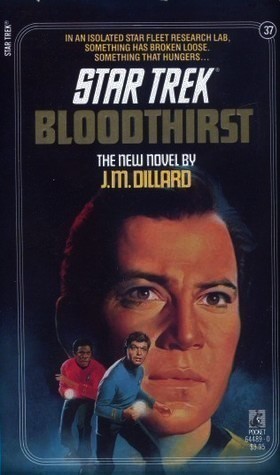
Star Trek - Bloodthirst

'Maybe it was an illusion created by the shadows, but the man's skin was gray, the expression pinched - like a corpse, McCoy thought, like a med school cadaver that'd been taken out of stasis and left lying around the classroom too long.'

Bloodthirst (#37 Pocket, #6 Titan) (1987) by J M Dillard is a vampire themed addition to the Star Trek novel series (as if you couldn't tell from the title) which I tried to hate, wanted to love and ended up with mightily confused feelings on the whole experience.

Back up.  Back up.

Bloodthirst is a book of contrasts, not just thematically but also in how successful Dillard is in writing.  The first half of the book is an uninteresting slog that takes far too long to get moving, but the second half is strong and keeps you turning the pages.  Misdirection of the reader promises a complex plot,  but in the end the simplest explanation was the correct assumption (Dillard appears to lose herself along the way).  Annoying 'OC' crewmembers take up far too many pages with their seemingly endless soap opera, but somehow I end up caring about two of them by the end.  And so on and so forth.  I'm pretty conflicted.  I feel like everytime I come up with a criticism, something else mitigates it, and when I find something I like I can recall something to the contrary immediately.   

It's not like Dillard was the new kid on the block at this point either.  J M Dillard is a pseudonym of Jeanne Kalogridis and Bloodthirst was actually her third Star Trek novel published.  Her previous titles were Mindshadow (1986) and Demons (1986) in which she develops two of her OCs Nguyen and Tomson.  I haven't read those two novels yet, so I can't really comment on them, but I am kind of looking forward to seeing how her writing developed (if it did).  Kalogridis (as Dillard - referred to here on only as Dillard) went on to write two more ST:TOS novels of her own devising and several ST movie novelisations, and many more stories set in the Star Trek universe.  She also has written her own original stories, including a few vampire ones.

It's funny, because as I was reading it (especially the first half) I was thinking that Dillard writes a lot like Vonda McIntyre, because of her overbearing original characters, and she ends up doing the novelisations for the films, just like old Vonda did.  She also, unless I am very much mistaken, also references one of Vonda's OCs Snnanagfashtalli (also seen/mentioned in 'Uhura's Song') two or three times in passing, but I'll be damned if I can find those references again, I should have put a sticky when I noticed them.  I have to admit that her likeness to Vonda McIntyre soured me a little towards her, but she managed to somehow mollify me later.  I should explain, I spent much of the first half of the novel wondering whether I should give Bloodthirst a 1 or 2 / 5.  I thought 1/5 would be a little too harsh, and that it was a solid 2... but somehow Dillard turns it around in the second half and Bloodthirst claws its way to 3/5.

Now I have to admit, I really do like Vampire stories, but, do they do well in Star Trek? Well, it's not like we haven't seen them in the TV series itself - what about the salt vampire?  The concept is the same, a parasitic creature who can pass as human and then attacks, usually killing the victim, sometimes creating more of themselves.  Bloodthirst takes the concept of vampire and tries to 'sci-fi' it with varying levels of success.  What I do like is the whole 'vampirism' as a disease and medically explicable, it's still scary without the mysticism - it might actually be more scary when talking about a potential plague - but I think it was a mistake to try and shoehorn the vampire mythos in.  Dillard feels the need to explain the mystical vampire by having Spock explain it, and then later Chekov reveals his crucifix (given to him by his Russian grandmother, naturally) which means he'll be safe.  Urgh... if the crew aren't bothered with the mystical aspect, either because they are ignorant of folklore / literature (which always bothers me when it comes up, why do they always have no idea of these things?) or they simply have no time for it when it can all be solved with an inquisitive mind and science.

It's not a secret that the 'vampirism' is a man made virus, that is clear from the beginning, what's more pretty early on Kirk, Spock & McCoy realise that they have stumbled onto a bio-weapon hot lab associated with Starfleet.  They are also right on the money when they name an initial suspect, although Kirk uncharacteristically flip flops between trust and distrust.  Dillard tries to throw red herrings out, but they are easily identified as such, and consequently much of the time I spent cursing the characters for their epic shortsightedness.

Speaking of characters, Kirk, Spock and McCoy were at times weakly written, which I think is a symptom of authors wanting to write their original characters how they wish and then bending to established characters to support their creations.  This weakness is confirmed as the story progresses, and the OCs take a step back and Kirk, Spock and McCoy wrestle control of the plot.  That being said, I did get attached to one of the characters - Stanger - who I thought was particularly well constructed.  However, as nice as he is he doesn't quite merit the amount of time lavished  on him and his companions  at the expense of good characterisation of existing characters.  I feel that they could easily have been substituted for other members of the bridge crew (who get very little time), which would be preferable to the security personnel soap opera, which kind of feels like 'upstairs, downstairs' in space.

The villains are a little wishy-washy, their motivations a little weak.  The 'vampire' is a pretty sinister character, satisfying to hate, but the other main villain (and his allies in Starfleet) is unconvincing.  The motivations of these people to do what they were doing was only understandable to a point, the scale in which they wanted to revenge themselves was far fetched and unreasonable to the extreme.

Additionally, there are many loose ends, for example the Vulcan spy, Sepek, or the fact that Starfleet knew about the research (because of Sepek) but did not step in to avoid pointless deaths or take any action.  Kirk was essentially left to his own devices and Starfleet stayed silent.  This just seemed very clumsy - Waverleigh didn't have to die, it was painfully obvious what was going on, why didn't Starfleet intelligence intervene?  How did the admiral and assistant get to Tanis?  Where was the ship which got them there?  How were they going to get away with it... we'll never know!

Anyway... Bloodthirst is ok.  Decidedly middling, nothing to really write home about, but not particularly offensive either.  I mean, you could always do worse I suppose?  If you like vampire stories you might want to give this one a go or, perhaps if you like 'strong' original characters then this might suit you.

3/5 - No Dracula

Wednesday, 4 January 2017

Star Trek Legacies - Captain to Captain

"Right on schedule," Kirk observed.  "I always heard that she was known for her punctuality."
"You heard correctly, Captain," Spock said.  "In my experience, she is admirably precise in all matters."

Ok so, there's kind of a funny story to go with reading this one.  Well, I go away to visit the family for Christmas and then manage to not take a single book with me to their place because my bag with my life in got left at our place.  I was not amused to say the least.   Anyway, after Christmas we went shopping, there happened to be a Waterstone's book store, I went straight to the Scifi section (you know the drill)... and would you look at that, somehow I ended up buying the 50th Anniversary 'Legacies' trilogy.  Considering I have 127 books on their way to me by mail, my partner was not amused... but The Special 50th Anniversary Trilogy hunny!

Before I launch into the review proper, I'm going to clue you up on The Special 50th Anniversary Trilogy (I just like putting it in bold, I get kicks out of strange things) is.  As you can probably guess (unless you are a Hitchhikers Guide to the Galaxy fan) there are three books in this trilogy (not four)  and they are as follows:

Star Trek Legacies

Book 1 - Captain to Captain by Greg Cox
Book 2 - Best Defence by David Mack
Book 3 - Purgatory's Key by Dayton Ward & Kevin Dilmore

So, we've got a trilogy written by four different authors, not particularly unusual.  If Greg Cox sounds familiar, you may have read one of some of his many Star Trek novels, or you might have read my Child of Two Worlds review.  I've come across the names of the two other authors once or twice before but I don't think I've read anything by them.  I've got to admit, I'm a little disappointed that there are no female authors involved in this project, considering the number of female authors who have written Star Trek novels and how influential female fans have been to Star Trek generally.  Are there no active female authors in the Star Trek novel world at this point in time.  Sorry rambling again.  Anyway, Greg Cox writing the first novel can only be a good thing right?

The Legacies trilogy was initially released from June to August 2016 with the paperback releases running from July to September 2016, all ready for Star Trek's 50th anniversary in September.

For the cover art on all three books they have employed Alan Dingman and used the more 'photographic' or should I say 'photoshop' style for the covers.  I'd say the strongest cover of the three is 'Best Defence' while the weakest unfortunately is 'Captain to Captain'.  The three books are colour coded Captain to Captain is predominantly green, Best Defence is most definitely blue and, Purgatory's Key is... red.  Have you twigged yet?  The original colour for the command uniform was green, science is blue and red is operations / security; they have reflected the uniform colours in the colours of the books.

I have to admit, the cover didn't win me over immediately, although I was intrigued by Number One or 'Una' being on the front next to Kirk and Spock.  I was torn between getting the trilogy and a book with a prettier cover, but as you probably gathered, the trilogy won out in the end.  Probably because book two has a very pretty cover.  You'll notice on this one though, that Number One has got captain's braid on her sleeve, unsurprisingly Miss 'Number One in everything' got busy climbing the ranks in Starfleet.

Being the first book in a trilogy, Cox has a lot more play in how complex a story he can create.  Being a planned trilogy he doesn't have to worry about wrapping the story up in one episode, and certainly doesn't have to worry about tying up any lose ends or returning the universe back to the status quo by the time he types his last word.  This kind of freedom cuts both ways for Cox who has the opportunity to play with a character he really seems to love and get on with but consequently seems to spend a little too much time on her.

Captain to Captain (2016) revolves around a secret, a secret that only the captains of the Enterprise and their trusted first officers have knowledge of.  The secret is a key which has been concealed even from Starfleet and kept on the Starship Enterprise since the time of Captain Robert April (the 'first' Captain of the Enterprise) through to Captain James T Kirk (the 'third' Captain of the Enterprise).  The 'key' is a device that can open a door to another dimension from which a race of technologically advanced but hideously paranoid and genocidal 'slugs' hail.

The officer who first led the mission which ended with sending the 'slugs' back to their dimension and acquisition of this mysterious key?  None other than 'Number One' or 'Una', who is of course Majel Roddenberry's (nee Barrett) character in the original pilot.  In Captain to Captain, Number One is back now as 'Captain Una', on track to being promoted to Commodore Una, she has to act fast to undo mistakes of the past before she is stuck behind a desk and new territorial lines are drawn which may put the Libros system deep in Klingon territory.  Captain Una takes a well considered risk and steals the key from a secret compartment in Kirk's quarters and escapes from the Enterprise and into the Libros system, slingshotting herself around a sun to give herself the edge over a pursuing Enterprise.  At this point I expected some cooky timetravel escapade, but instead I was forced into a walk down memory lane which felt like it was never going to end.   Una's 'adventure' is actually her recollection of the first away mission she lead, which of course went hideously wrong.  For all intents and purposes it really shouldn't have gone wrong, Una is apparently an incredibly able and intelligent Illyrian, but... she's also remarkably dull.  I rather liked Cox's rendition of her in Child of Two Worlds where she is competent and no nonsense, but here she seems stricken with ISS and a strange psychosis where she keeps reminding herself (and us) that she's number one in everything, aside from critical thinking.  Perhaps I'm just suffering from 'Number One' over exposure, since about 80% of the book over concerns itself with her.  Kirk and Spock are on the cover just to reassure us that they will have a part to play eventually.  I have to admit, I don't find young Una a very compelling protagonist.  ANYWAY long story short, her away mission crew get transported into an alternate dimension by the horrible slug people, the secret item is the key for unlocking the stargate device that could bring them home.  Unfortunately, at the time she was unable to manipulate the machinery to bring them back (and she was explicitly told not to by the good slug person), but now, in a nice link to the episode 'Mirror Mirror' and her excellent memory she is confident that she can bring them back, if they are even alive.  After an incredibly protracted sojourn in the past, we return to the present to follow Una again and watch her cock up again until she finally meets up with a waiting Kirk & Spock who finally get some action.   

Predictably, although she can manipulate the machinery, the arrival of the Klingons gives her little time to locate her crew members to bring them back, so she goes into the desolate alternate universe to find them, hoping to bring them back to the right location in 30 days and have Kirk and Spock operate the machinery and bring them home.  Of course, the Klingons are now swarming the place and coming back to the planet seems almost impossible.

Kirk and Spock are then left to their own devices to escape the Klingons, which they do, but not before their ship is irreparably damaged and only get saved by the Enterprise in the nick of time.

Kirk and Spock seal the Key back into the new safe in the Enterprise, and finally let McCoy in on the secret, since not trusting your crew mates /  friends is what got everyone in this mess in the first place.

There's a plot twist right at the end, clearly marked with flashing neon signs.  It's incredibly contrived and irritating.

End of Book 1.

Number One is kind of a problematic character, in that she's this super confident, super able officer and she has apparently always been this way but suffers from the author's attempt to make her young and inexperienced - think what Vonda N McIntyre did to the crew in her abomination 'The First Adventure'.  It was quite surprising actually because Cox's treatment of Number One in Child of Two Worlds was really strong and a really nice expansion of the character.  Cox obviously has a love for the character of Number One and I can see his enthusiasm, but... I can't feel it.  It's unusual but, I didn't dislike the character but I felt a little confused over what she actually was.  Oh sure, I know she's an Illyrian, I know she's outrageously competent, I know she prefers trousers to skirts but I don't know why she has to keep confirming her competence.  I don't think she's arrogant, she just knows she's the best and it's true, but then why does she have to confirm her actions or her intentions or her abilities over and over again with internal dialogue like 'because I'm Number One'?  Is she actually nervous? Neurotic?

I agree that if you are going to use Number One for any length of time then you've got to do something to the character to bring her down to earth, but even with her slight neurosis and hideously stupid mistakes she remains unrelateable - which is a problem when 3/4 of the book concerns itself with her.  Although her idiosyncrasies and illogical actions were at times frustrating, she doesn't spoil the book, I just got the feeling that there was a better was to express her or perhaps a better way for the events to unfold.  Perhaps, for example, it isn't her leading the landing party and she has to fix other people's mistakes but it's too far down the pan for even her outstanding abilities.

I don't want to give too much of the idea that she's a bad character, you might have less of a problem with her than I do, and certainly it's not a bad story by any means. It's just a little weak at times, which I can only really attribute to the prolonged section in the middle with Una (formerly Number One)... and then the prolonged section in Enterprise's 'present' with Una.  I'm Una'd out! 

Pretty much the only interaction with the TOS crew is between Kirk and Spock, McCoy is pretty much written out Captain to Captain pretty early on and other characters are just bit parts.  Even so, characterisation is both good and bad in equal measure.  In the first part of the book, before the story jumps backwards to Number One's first away mission, nothing really jumps out at you as being inconsistent.  Again the focus is on Captain Una and not on the Enterprise crew, interaction is limited to Kirk and Spock exchanging furtive glances and shutting down McCoy's enquiries.  The final section of the book (post Una's departure) details Kirk and Spock's escape was fast paced but also had the most lapses in the characters of Kirk and Spock:

"I think I've had enough of you piloting, no offence"
Spock gave him a bemused look.  "If I had feelings they would be hurt."
"Somehow I doubt that."

Yeah, that face you're pulling?  That's my face too.  I'll make sure we're on the same page with an emoji - 😒 .  The less said about that stirling dialogue the better, yes?

Some reviews I've read for this novel have been glowing, others less so.  For me personally, it was OK, middling, worth reading but nothing special.  I'm still looking forward to the rest of the trilogy though because the story is interesting and I'm also looking forward to seeing what the other three writers are going to bring to the table.  First books in a trilogy are always pretty difficult for writers, especially when they are only writing the first volume, and while I don't agree with other reviewers that the instalment can stand alone, it's merits aren't completely dependant on a follow on story.

3/5 - Time to change pilots.

Hope everyone had a wonderful Christmas and a happy new year!  FYI, I'm in a good, rested mood, I'm not just being mean!  EDIT: Also, I can't seem to spell... ahh well, all fixed!