Showing posts with label Chapel. Show all posts

Friday, 11 August 2017

Star Trek - Mindshadow

She turned sideways in order to face Kirk directly.
"You have requested a replacement, haven't you, Captain?"  She looked from the surprise on the captain's face to McCoy, whose eyes were downcast.  "Perhaps you haven't been told the true extent of Spock's injuries."
"Are you telling me Spock will not return to duty?"  Kirk's jaw tightened so much it ached.
Her eyes were sympathetic but unyielding in their honesty.  "That's one possibility.  The best we can hope for is that it will be months before Spock is able to return to duty again."

Mindshadow (#27 Pocket, #41 Titan) (1986) is J M Dillard's first flirtation with novel writing and I guess, how she got 'outed' as a Trekker to her husband whom she had been keeping in the dark about her obsession by surreptitiously acquiring and reading published Star Trek novels.  She even wrote Mindshadow secretly and sent it off without anyone else reading it (Starlog - Issue 125).

I like the cover this time...
It's kind of clever...
I've previously reviewed Bloodthirst, Dillard's third Star Trek novel and I went back and cribbed it before I started this review.  In some ways Dillard improved between Mindshadow and Bloodthirst, but the weaknesses that reared their heads here in Mindshadow are still strongly affecting her work in later Star Trek instalments.

I'm happy I get to use a new term I picked up (from Joan Verba) to describe Mindshadow - it is to a certain extent a 'get'em' story and for once it's a 'get Spock' story instead of a 'get cinnamon roll Kirk' story.  Spock suffers a devastating injury to the left side of his head after falling down a cliff while investigating strange tricorder readings on a beautiful garden planet with technophobic inhabitants which pirates have been raiding.  The Federation has been asked to help these people protect their world and way of life however this all goes awry when the attacks do not come from above, but from below.  

Spock's recovery is not certain and McCoy sends for a specialist in Vulcan neurology to ensure his best chances.  When she comes (a petite, small, woman... doctor... very talented... excellent at hand to hand combat... everyone loves her - I'm sure I've seen this character before...) it soon becomes clear to the reader (if not the characters...) that she's not what she appears.  Unfortunately, the Federation's success depends on Spock regaining his memory and solving the mystery on Aritani, but his recovery is slow and he's dogged by saboteurs, who even go as far as slitting his wrists...

Kirk however can't just sit and wait for Spock to possibly recover, he must continue to act without his first officer, but every move he makes is countered and he soon comes to realise that he has a traitor on board when a captured Romulan pirate is killed in the brig, and unauthorised transmissions are being sent from somewhere on the ship.  Members of his crew are killed on Aritani in a devastating attack, and Scotty is framed as a murderer!

IN ADDITION to all this, McCoy has fallen in love with the new doctor - Emma Saenz - and she with him... but she also rather fancies Kirk... and he her... and everything goes terribly sour.

Kirk also has to ferry diplomats to Vulcan, which of course results in murder and general mayhem.

AND Spock ends up going home to Vulcan in order to get well again, meets another hybrid, faces an assassination attempt, gets framed with murder and gets his wrists slit... again.

To conclude the Enterprise returns to Aritani, Kirk gets the Romulan treatment (because who doesn't like Kirk with pointy ears... aside from Spock!) and things end with a bang!

I think you'll probably agree that there's a lot going on there and to be honest there are far too many things going on for a 250 page paperback.

I mean, it's a very sweet book in that there is some serious passion and love for Star Trek there... but it does feel like Dillard is trying to write her favourite episodes into her book, she's trying to do everything at once and the novel suffers for it.  For example, she obviously really liked Kirk getting pointy ears and Spock making disparaging comments about it, so that went in.  She also liked Journey to Babel, as she somehow manages to fit in the Enterprise collecting diplomats and even a murder!  I think for every element there is an analogue in the original series, and there are a lot of elements.

Characterisation is variable and my biggest disappointment was probably due to there being too much going on and too few pages to do it in.  I was all geared up for some touching K&S, you know the unbreakable friendship on the cusp of being broken because Spock would possibly never be 'Spock' again.  It looked like it was going to happen, I would be indulged and my heartstrings pulled in that bittersweet way that makes fangirls swoon... but... time passed, Spock got marginally better and the scene was never written... and Kirk apparently stopped visiting so much.  The hinted mental link?  Not really used.  Kirk knowing that Spock even in his mentally compromised state wouldn't try to kill himself - well he gave Spock the benefit of the doubt.

But where was that marvellous scene I was waiting for?!
It didn't happen.

Reunion after Vulcan...
Didn't really happen there either.

To be fair though, although I didn't see the emotional scene I was waiting for, I did get Spock related cinnamon roll Kirk angst, where Kirk didn't sleep for two days and was an irritable sod because Spock was in critical condition.  I suppose I can be appeased that way.  Plus there is quite a lot of emphasis on the 'love' between the trinity, the friendship, which I think thematically ties in well (especially with the movies...).

Characters at time seemed to be hit with ISS (inexplicable stupidity syndrome) quite regularly, including McCoy who apparently couldn't tell that Emma Saenz was Romulan... I mean come on.  Her body temperature was Vulcan high, she didn't sweat in high temperatures... and she was really strong... I don't think you can even put it down to building muscle from being on a high gravity planet...  McCoy has sexy times with her and still doesn't realise she isn't human!

Kirk was quite well characterised I think, although he did seem emotionally neutered at times... I do think we could have done without his attraction to Emma Saenz and the little love triangle that developed between Saenz, McCoy, and Kirk.  Or perhaps it was just an indication that Kirk has a preference for lovers with pointy ears (hohoho... I'm kidding, I'm kidding)?!

There was one particular bit concerning Scotty which made me quite annoyed.  It was his reaction to Kirk when her thought that Kirk had talked about his feelings over one of his engineers being killed.  His disrespect and jumping to conclusions about his captain did not sit right with me.  Again, it was a story element that didn't need to be there.

As for the original characters, there were two of note.  Firstly of course Emma Saenz, who at times is well constructed and at others utterly frustrating.  She's an interesting character, but because Dillard drops the reader lots of not-so-subtle hints rather early about her identity she's a little too transparent.  If Dillard had chosen to reveal her a little later it would have worked significantly better.  I was confused at one point about her position as a double agent and Admiral Komack's insistence of keeping Kirk in the dark,  I don't really see what her purpose was in her double agent role when she was on the Enterprise?  What benefit could she have been to the Romulans then?  It's a little bit contrived, why couldn't Spock recover, why did it have to be her?  Why couldn't they have just used another doctor?

The other character is Lieutenant Tomson, who appears in more books by Dillard and I think in one or two by other authors too.  Tomson is... infuriating but in a very fallible way... She isn't overused which is a good thing but unfortunately is involved in the erroneous murder charged levelled at Scotty.  This and the murder of one of the diplomats seem to be engineered so that Tomson can do something...  But as I've mentioned before, those elements could have been left out entirely.

Oh!  There's also Spock's replacement Varth...who is a nonentity...

The conclusion of the novel is a little weak and more than a little rushed, which could have been avoided if Dillard had kept the story a little more simple and done some serious editing.  Personally I would have cut out a lot of the superfluous bits of story in the middle and extended finale, given more details of the complex, more details of the Romulans, made more of the adventure and of Kirk and Spock working together again at the end.  As it was it ends up being a little bit flat, not terrible just a little lacklustre.

I did enjoy this book however.  Dillard proves that she can write characters well and she's especially good at dialogue, but her narrative structure is messy and she makes far too much of linking the events in the novel with events in the series and the animated series (of course, it isn't worse than Marshak and Culbreath actually footnoting all their references).

I'm going to be nice however and give Mindshadow a generous 3/5 - since a two would be overly stingy since it was a frustrating pleasure to read.

Thursday, 22 June 2017

Star Trek - Corona

Kirk was eternally fascinated by the procedures for making the Enterprise ship-shape for a long voyage.  He was familiar with every action as a man watching his wife dress in the morning, and yet... it had that same sort of fascination, of responsibility mixed with a perverse and impossible kind of ownership.  No individual could own a star ship, any more than a man could actually own his wife.  Still, the Enterprise was his.  He wondered what the day would be like when he had to give her up, and whether, if any of his Starfleet colleagues assumed her command, they could possibly remain friends.

Corona by Greg Bear (#15 Pocket, #24 Titan) (1984) is a really interesting instalment in the Pocket novel series for a couple of reasons.  Firstly, we're seeing the theme of entropy again, and this is really exciting for me because I'm finally seeing what I expected to see in the novels that is patterns and trends in themes and content of the novels.  Secondly, for the first time I'm seeing direct references to Gene Roddenberry's 1979 TMP novel and in Greg Bear's case, he has borrowed (to a certain extent) the writing style, characterisation of Kirk, and taking relationship cues from it too.  I was most surprised at the relationship inferences because I didn't expect them from a male author.  Finally, it's interesting because its time line is incredibly kooky which makes it a little confusing as to when exactly the novel takes place - I'm going to run with any time.  I can only imagine that the majority of the story was cooking for a long time (pre-films) and so there's some artistic license in there too.

Greg Bear himself is still an active author and although Corona was his first and only Star Trek novel, he is still active in the community.  Bear writes a wide selection of fiction, including tie-in novels for the Halo universe.

Find more about the author at his site www.gregbear.com and on his page on imdb.

Corona itself is, for me at least, a 'so-so' novel.  Whilst I was reading it I would visualise a big 3/5 stamped across the cover.

Read a brief summary of Corona here (memory beta).

There are lots of problems with it for example the time line is pretty much as kooky as you can get.  The novel listing I often refer to lists Corona as taking place in 2270, which is just after the original series.  Keep in mind that TMP occurs in 2273, got it?  Ok, there's this funny 'dating' (not that kind) paragraph:

Spock sat stolidly on his immaculate stone meditation plank, eyes closed, deep in mathematical exercises he had taken up lately, conditional to his entry into the third stage of Vulcan life at age seventy-nine.

Hold up!  Seventy-nine?!  Spock was born in 2230 and if this is 2270...  That makes him forty, surely?  Much of the narrative implies that it is within the scope of the five year mission, but why age Spock this way?  Is Kirk supposed to be older too?  And where does this leave poor Amanda and her age, and Sarek for that matter?  Anyway, I think it's safe to assume that it is 2270 and not later because the rest of the crew are present and in their same positions - even Yeoman Rand is there!

Bear has an odd take on Vulcans at times too, strange little rituals and ticks.  The story very hinges on the Vulcan 'otherness', but in making them a little too 'other' or 'strange' they kind of feel a little odd to me.  I can't pin it down well, but it's like seeing through a glass darkly.  I can accept a certain amount of artistic licence but sometimes there's some strange 'insight' from these authors, possibly because it is before much of the 'official' details of the Vulcan species had been finalised.  It was interesting however to have Vulcan children play a role as we don't often see Vulcan children portrayed (there's little reason to).  I guess they are essentially little adults, ignoring of course the brats who bully Spock in the AU (who frankly just act like bully children, not something 'other' as I imagine Vulcan children to be).  The resolution of Corona hinges on the fact that the child Vulcans haven't gone through a ritual to make them adults, and although this does happen canonically I don't think it is supposed to be an event which comes from without, but instead it's the completion of a trial which marks them as adults.  This kind of ties into a loose theme of 'coming of age' but it doesn't really dwell on this too much and appear somewhat accidental (even if this links into 'Mason's' story line.

Anyway, none of that is really that interesting, I just needed to get some of those thoughts out the way.

The first thing that I really noticed while reading Corona was that it is the first novel that has really drawn from Roddenberry's TMP novelisation.  The characterisation of Kirk, his somewhat uncomfortable phrasing and too-long idling over sexual thoughts - they are all there in Corona.  References to the telepathic connection between Kirk and Spock are in there too - and certainly their closeness.  Furthermore, I think that this is the first instance of the brain implant being referenced, which also makes its first appearance in the TMP novel.  I am surprised that it has taken this long for these features to make their appearance in the novel series thus far, or at least a real indication that writers have read the first book in the Pocket Book series (the TMP novelisation).  Ok, perhaps I'm deliberately ignoring Marshak and Culbreath because of their blatant agenda and kinks, their two additions to the series (Triangle and Chains of Prometheus).  I really like that it's a man picking up on these aspect too, quietly adding in the telepathic link between Kirk and Spock that kind of rumbles in the back ground of their relationship.

Of course, it does fit in with the story with Kirk should have the implant as mentioned in the TMP novelisation.  Much of the novel is given over to 'the monitors', a computer system installed at the beginning of the story, with the capacity and authority to override commands / requests of personnel on board the Enterprise.  They are meant to prevent for example, captains from making bad decisions, if the monitors disagree with the captain's decisions then they will override the captain and take action without anyone else's say-so.  There are also monitors for sick bay too, much to McCoy's chagrin.

Does anyone else find this uncomfortable?  I certainly do!

Kirk doesn't care for it much either, but with little choice given to him he has to play by the rules.  He ends up with an additional monitor as well, in the form of a young woman reporter.  I was actually really happy to see this story line used, because this is the first instance of the 'reporter / monitor' character and really the first time we see this kind of... conflict within Starfleet where they are trying to tighten control of their fleet and personnel.  Bureaucracy of course is seen in the original series, but certainly in TMP we know there are problems on earth and Starfleet is under pressure from 'New Human' groups.  A later novel that I have reviewed with a similar theme of Kirk having a monitor is The Starship Trap.  Ultimately, the female monitor in both novels ends up being a boon to Kirk, but interestingly there is no romance involving Kirk in either of them.  The 'monitor' storyline is tied up by them being judged not fit for purpose, with the moral that commanders (and medical officers etc.) should be able to act as they see fit in the circumstances, without any computer intervention.

Interestingly, the monitors do take control away from Kirk in the end, because he chooses to hold fire.  He felt conflicted about firing on the station and thus possibly killing Spock and Mason in the process.  The monitors fired on the station because Kirk didn't want to act, because he was 'too concerned', and that possibly he didn't act because he knew the monitors would take the weight off his shoulders and make the decision for him.  In a way this is a challenge, would the imposition of these monitors stop people growing?  Stop them from being the best humanity has to offer?  Additionally, Kirk's humanity and respect for life makes him who he is, his judgement not to fire, his empathy being over-ridden by an algorithm... would a captain ever be truly followed when the crew knows their judgement is going to be constantly judged and changed by an algorithm on a computer?

Just a thought.

Finally, I was really interested to see the theme of entropy appearing again.  It certainly seems to be the strongest / most common theme so far, especially since the last use of it was in The Wounded Sky, the last book but one, the first was The Entropy Effect.  All three stories have dealt with the theme a different way however.  The Entropy Effect was caused by the actions of a man and has to do with time travel, The Wounded Sky again is to do with the actions of scientists but concludes with the meeting of a new, God-like, life form.  Corona handles it differently again, a non-corporeal life form wishes to accelerate entropy in order for it to cause the end of  our universe and the rebirth of the environment needed for it and its species to exist (essentially the big bang).  Funnily enough, it also has to use technology to achieve its goals, which it achieves through using the Vulcans as its arms and legs and the frozen 'sleepers' as memory storage units.

The 'action' of the story is a little bit messy and at times the author seems to forget which crew members are present (poor Chapel!) and whether they are capable of critical thinking at all.  The story itself feels like it was written some time before publication, perhaps even before TMP but was revised afterwards to add in extra bits of lore.  Unfortunately it doesn't seem to have been edited enough to make the old and the new mesh and the story can be somewhat bitty as a result and unfortunately at times, pretty contrived.  However, on a whole its passable, and it is obvious by Bear's success that he improved greatly in subsequent books to working on other popular sci-fi franchises and series of his own design.

For the modern reader, the story feels quite tired.  I think in particular using the trope of 'possessed children' but then not really building on that as something scary was a bit of a let down.  Perhaps that was somewhat endemic in the whole book, things were kind of introduced but the ideas weren't really developed, almost like the author didn't know quite where he wanted the ideas to go.  The idea of the monitors was built on, but when it came down to the execution of their orders over Kirk's it was a little... anticlimactic.  Mason's xenophobia never really peaks, and her character development just doesn't seem that compelling.  That being said, on the subject of characterisation, I did enjoy the Roddenberryish portrayal of Kirk's character, Spock's wry moments and McCoy's humourous, cantankerous nature.  I think Bear was a little weak on the development of the female characters though - Chapel's description as 'spinsterish' was particularly harsh!

3/5 - take a cold shower Kirk!

Thursday, 8 June 2017

Star Trek - The Trellisane Confrontation

Kirk had been staring into space, not lost in thought, but helpless and hopeless, stunned by the loss of his ship.  He had never felt quite so abandoned, so lost, his very foundation removed.  McCoy leaned toward him and said softly, "Jim.  Captain Kirk!"

I have to say I was elated on reading The Trellisane Confrontation by David Dvorkin (1984) (#14 Pocket, #31 Titan), after all I was bracing myself for a literary blooper after having three excellent books on the trot.  After the hit and miss approach to the first ten books in the series, I have to admit I was getting a little downhearted at the prospect of having to suffer more of the same in books #11 to #20.  Honestly, it's like they turned a corner at Web of the Romulans, hopefully they don't look back?

That isn't to say The Trellisane Confrontation doesn't have problems, it does... a surprising amount in fact considering how short it is but it does have more of a feeling of an episode than the previous three books, which felt like they could never really be episodes (I acknowledge The Wounded Sky was adapted to a certain extent for an episode in TNG).

Okok, note on the cover.  Accurate uniform on Spock, this novel takes place in 2269, so during the original five year mission.  I actually like this cover a lot, it's colourful, it's fun... it's... who is that woman in the middle?  I was waiting for a damsel to appear but uhm... she doesn't?  I had a thought that it was supposed to be Chapel, but then why not put her in uniform, and I don't really think she fits the description of the warrior women of Nactern either, other than those mentioned and other than Uhura (who it most definitely isn't) there aren't any other female characters?

Edit:  Ok, people seem to think it's Christine Chapel...  I'll believe them, I suppose Spock looks facially squiffy too...

The Trellisane Confrontation follows a quite a simple plot.  The Enterprise is transporting dangerous criminals who are affiliated to a political faction who wish the Federation to go to war with the Romulans.  Whilst transporting them, Kirk decides to go to the aid of a peaceful, neutral, planet being attacked by it's aggressive sister planet in a system in a precarious position between the three powers (Federation, Klingon Empire, Romulan Star Empire).  Spock and McCoy express their reservations about going to aid this planet with dangerous prisoners on board, but Kirk is adamant and proceeds without confirmation from Starfleet.

Naturally, everything goes wrong.  The prisoners on the Enterprise escape and gain control of the ship in order to try to start a war with the Romulans while Kirk, Spock and McCoy are on Trellisane.  The Trellisane people are not the peaceful progressive people they appear to be, the attacking Sealons and Klingons step up their invasion plans, and Spock and Kirk are captured by the Klingon and Sealon forces, leaving McCoy to organise a the Trellisane people and uncover their dark secrets.

That's the set up for The Trellisane Confrontation, and although a little simplistic at times the first half is a pretty strong and enjoyable read.  The pacing is good, it doesn't sweat the small stuff and expects the reader to fill in some gaps.  However, in the second half of the novel Dvorkin appears to lose impetus and aside from a very interesting section with Christine Chapel melding with an alien it doesn't have many other high points, in fact I became quite irritable about some inconsistencies I couldn't un-see!  The novel resolves itself a little too quickly not allowing Dvorkin to really get the meat (ha) of his story.  We get a need to know exposition via McCoy of the Trellisane culture, a rather pathetic bunch who are essentially cowards and cannibals.  The Sealons, the species being manipulated by the Klingons turn out to be a bit on the rough side but rather more likeable than the Trellisane people, despite never hearing a word directly out of their mouths.  The political situation gets resolved in a couple of pages... and Klingons and Romulans beam straight onto the bridge for discussions?

My main complaint however is what I can only suggest are strange, loose, narrative threads that by the end of The Trellisane Confrontation are not resolved.  The odd moralising at the end which attempts to give an illusion of tying those threads but really just leaves them broken.  This is really shame because it really does spoil the book, in my estimation, after a well paced and pleasant first half.

Here's an example; Spock notices behaviour he doesn't like in Kirk, and this rattles him and his confidence in Kirk.  Personally I didn't see a problem or out of the ordinary behaviour, but I ran with it.  I spent from that time onwards waiting for some sort of revelation that something was wrong with Kirk, like, there's something in the air on Trellisane, or there was something in that delicious delicious meat her ate... but it's nothing.  It turns out that Spock hero-worships Kirk and just hadn't seen this aspect of him before...  We are in the same year as The City on the Edge of Forever guys...  you know each other quite well at this point!
Spock followed him, and as Kirk leaned over to offer him a hand to help, Spock was amazed to see that his captain's face wore a broad grin.  It was something beyond simple levity or the release of long suppressed tension, Spock thought; it seemed more the joy of a young boy on a long-awaited long-delayed holiday.
(...)
Now, suddenly, the control seemed to have disappeared.  In this earnest, deadly business, James Kirk was behaving with boyish glee rather than the calm determination Spock night have expected.  Kirk was dropping to the level of the average human, and Spock, who would have been greatly insulted had anyone suggested to him that he was capable of hero worship, was deeply disturbed. 
 This actually connects with analysis of the criminal who takes control of the Enterprise.  In several sections the criminal (Hander) is likened to Kirk and in a final exchange with Spock and McCoy, they underscore their similarities.  Now, I might be a Kirk devotee, but I think this is a bit of a stretch and Spock and McCoy's final condemnation? criticism? of Kirk's character and actions during the events of the novel was quite inaccurate and very unfair.  Kirk was right to be angry about what they were saying!

The slave/cannibal aspect of the Trellisanians was interesting, especially when reflected by McCoy.  I particularly liked the 'not all as things appear theme' which was prevalent, and probably does the best job at holding the story together.

The subplot (?) on the Enterprise where Hander Morl and his five alien allies take control of the bridge was actually pretty enjoyable, and I especially relished my least favourite character Sulu being the one to cock up utterly and cause the whole situation.  Chekov's scenes were excellent, and his trying to emulate Kirk was wonderfully written and very funny.  Uhura was very much in the background but what did surprise me was as mentioned before, Chapel's section.  I think that was very well done although ultimately she doesn't reveal her experiences.

Ultimately, The Trellisane Confrontation is an enjoyable book and well worth a read.  It doesn't reach the heights of The Wounded Sky or the tension of Mutiny on the Enterprise, this book is smaller in scope and less detailed than the previous couple of novels.  Characters are a little out of character at times, although Dvorkin seems to be better at characterising the likes of Sulu and Chekov than Spock and Kirk.  Action is a little disjointed and at times frustratingly sparse on details, but not necessarily bad.  I don't think The Trellisane Confrontation adds anything to the existing characters, Dvorkin does create an interesting culture in the Trellisane species.

3/5 - don't order the steak.

Friday, 3 February 2017

Star Trek The Motion Picture - Novel - Gene Roddenberry

I actually read this about six months ago, but I didn't want to write about it until I'd watched it again... and I didn't want to watch it again before I'd rewatched TOS.  So FINALLY I get to write about one of the most thoughtful and beautiful novels which just should be an essential counterpart to the film.

The Star Trek The Motion Picture novelisation is actually the only Star Trek novel Gene Roddenberry  wrote himself, which is both wonderful and sad - wonderful that we get to see his writing and ideas 'first hand' but sad because it is only the one novel, and he has a wonderful writing style.  One of the things I have read about Roddenberry is that he was a 'big picture' person - big ideas, but leaving the details to others - however this novelisation is all about the details.

My first introduction to the novel was actually via 'the Roddenberry footnote', which introduces the concept of th'yla - more on that later - of course I had to read the novel after reading just a footnote on it.  Following up the footnote subsequently caused me to read William Shatner's first biography Where No Man, which gives some insight to Roddenberry's thoughts going into the movie and the kind of influences on him at the time.  Incidentally the two women who wrote Shatner's biography (which takes the form of, in many parts, interview) are also the writers of a few Star Trek novels published through Pocket Books and I happen to be reading them at the moment.  They seem to stick very closely to the sentiments expressed by Roddenberry and Shatner as well as the details in the Star Trek The Motion Picture novelisation.

The reason I suggest that this novel should be an essential counterpart to the film is because there is a lot of explanation and expansion of scenes and characters.  For example, why are the characters in the transporter accident significant?  What happened to Kirk to change him from that charismatic leader to the dour, broken individual we see through most of the film?  What does Spock telepathically sense on Vulcan?  What were Spock's motivations for purging himself of emotions once and for all?  There's a whole host of questions left unanswered by the film that do have their answers in the book.

Now I'm not saying the film can't stand on its own per se,  it can, but reading the novel and watching the film (preferably the novel before the film) just makes the experience a helluva lot richer.  I feel that this novel is what novel adaptations of movies should be, not just a cash cow, not just rehashing the story scene by scene, but actually significantly adding to the understanding of the film.

It's significant that Roddenberry wrote this much expanded companion to the film.  It's significant new terms are introduced and it's significant that it overtly adds what the film couldn't due to trying to bypass the censors or because it was trying to appeal to a broad audience.

For your information, I consider this novel 100% canon.  If this can't be considered  canon, I don't know what can.

Before I dive headlong into my gasping appreciation of the Kirk/Spock relationship exposé, which frankly is the whole point of the film I'll point out a few things which make the film that much more comprehensible.

New Humans - knowing about the New Human movement goes a significant way into understanding just why Kirk is in the situation he is in.  You don't learn about this movement in the film, but you do in the book, and you also get an indication of the malleability of Human thought and importance of individuality in an increasingly homogenous society in the preface (written by none other than Kirk himself of course!!).  The implication is that Kirk was made an admiral and kept on Earth after the end of the five year mission as a figurehead representing the best of humanity and the pinnacle of individualism.  We get much description of how Starfleet and it's personnel are old fashioned and that the new and more advanced humans are moving towards almost a group consciousness and are wooed by greater intellects, something that we are told make them unsuitable for deep space exploration.  The New Humans are said to have been increasingly critical of Starfleet and Kirk was used as a pawn to secure support on earth.

McCoy left Starfleet in protest because they made Kirk an admiral despite his protests and his opinion that Kirk would not be suitable for the position:
'Upon learning that Admiral’s stars were to be offered to Kirk, McCoy had protested vehemently and had secured the backing of other prominent medical officers in the fight.'
McCoy resigned because his recommendations were ignored.  We don't know what happened in those last two years of the five year mission, but when Kirk got back, he wasn't the man we left at the end of the third season.  We also don't know what happened to make Spock leave (pfft), but we do know that Kirk couldn't process that at the time:
'Also, he had not really understood how deeply Spock’s abrupt departure for Vulcan had affected him. He had been depending on the Vulcan’s friendship and logic much more than he realized.'
 He (McCoy) knew his friend would be broken (and possibly was already broken) in his new position.  I have little doubt that McCoy realised Kirk was going to be used with little consideration to his mental health and as a doctor he couldn't stand by and watch it happen.

There are extra sections, extra insight from McCoy into Kirk's mental state in the book, and it is McCoy who redresses Kirk for his actions.  Their relationship needs time to heal, the slow speed in which it occurs however is a poignant indication of Kirk's broken state.

The novelisation adds significant observations from and about the rest of the crew which are not included in the film.  The original crew recognise that Kirk is different, that he's dangerous in his current state.  It's a testament to their belief and loyalty to him that they still follow him into the breach regardless, even when he has lost his charisma and charm.

We also learn about Lori, the woman who died during the teleporter malfunction.  Lori was Kirk's lover on earth in the first year after taking up his position in the admiralty.  She was sent to him by Admiral Nogura to 'heal and pleasure' him, which he accepted, however he knows that she was there to help control him on Earth.  He knows this, but is relatively unconcerned, he isn't vengeful he isn't angry, he just accepts it... he's completely dispassionate.  She was involved in Nogura's manipulation, which is made clear to him in scenes not in the film.

Of course, we also get a hell of a lot of insight into Spock's character, and into the relationship between him and Kirk.  In particular we get given the concept of T'hy'la and it's explanation in footnotes.  We also get told that T'hy'la is the term Spock attributes to Kirk - it means 'friend, brother, lover'.  I'm not going to go into an analysis of that now, that's a whole 'nother blog post, but we can safely say that at the end of the five year mission, something happened and Spock went running away to purge his 'shameful' emotions on Vulcan.  We get so much extra narrative about Spock's 'feelings' on Vulcan, we also get an explanation of what Spock 'hears'... He 'hears' Kirk thinking about him, calling out to him from Earth to Vulcan.  Spock fails to purge his emotions because of Kirk.

Spock refers to Kirk as his T'hy'la and all that implies, Kirk who lacks that word (presumably, otherwise I suppose he would have used it) he describes their relationship like this:
'But still it felt painful to be reminded so powerfully and unexpectedly of his friendship and affection for Spock - their had been the touching of two minds which the old poets of Spock's home planet had proclaimed superior to even the wild physical love which affected Vulcans every seventh year during pon farr.'
He lashes out at Spock when he is jilted, he wants to hurt him, but he also desperately needs him.  Even in this reduced capacity, once Spock is on the Enterprise again Kirk regains himself, and even Decker feels his respect towards Kirk increase.

Basically, if you want to learn about the inner workings of the characters, read this book, I'm barely touching on the additional content.

The novelisation has no qualms about the exposition of the two parallel  relationships of Decker/Ilia and Kirk/Spock.  None.  At. All.  The movie only thinly veils the comparison, the novelisation doesn't even bother.  And the overall theme of the movie?  That is basically sidestepped all the time (probably because of the two narratives) - love - you don't get to read that another way.  Love is referred to strangely in the movie / novelisation, have you noticed that Kirk calls even overt love 'friendship' - e.g. he calls Ilia and Decker's relationship 'friendship' and he hesitates and calls his relationship with Spock 'friendship' too.  I'm fairly sure that Kirk uses these terms interchangeably - much like the term 't'hy'la?  DAMN and I said I wouldn't get into this right now!

By the way, there are some extra parts to the um, 'sickbay scene' that make the whole thing completely 'un-misreadable'.  He is comforted, told that he didn't have to worry about 'shame', he 'clings' to Kirk, he feels 'needs'.

Q.E.D.  Roddenberry confirmed it right there.

The end of the novel plays out pretty much the same way as the film does.  There is an extra line at the end in which Spock banters with Kirk, indicating they are healed and that this is the start of more great adventures.

The novelisation is just... wonderful.  Wonderful companion, wonderful exposition, wonderful vindication.  Read it - I know I'm about to read it again!

5/5 - L.L.A.P

Wednesday, 18 January 2017

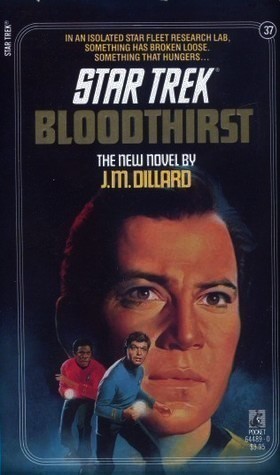
Star Trek - Bloodthirst

'Maybe it was an illusion created by the shadows, but the man's skin was gray, the expression pinched - like a corpse, McCoy thought, like a med school cadaver that'd been taken out of stasis and left lying around the classroom too long.'

Bloodthirst (#37 Pocket, #6 Titan) (1987) by J M Dillard is a vampire themed addition to the Star Trek novel series (as if you couldn't tell from the title) which I tried to hate, wanted to love and ended up with mightily confused feelings on the whole experience.

Back up.  Back up.

Bloodthirst is a book of contrasts, not just thematically but also in how successful Dillard is in writing.  The first half of the book is an uninteresting slog that takes far too long to get moving, but the second half is strong and keeps you turning the pages.  Misdirection of the reader promises a complex plot,  but in the end the simplest explanation was the correct assumption (Dillard appears to lose herself along the way).  Annoying 'OC' crewmembers take up far too many pages with their seemingly endless soap opera, but somehow I end up caring about two of them by the end.  And so on and so forth.  I'm pretty conflicted.  I feel like everytime I come up with a criticism, something else mitigates it, and when I find something I like I can recall something to the contrary immediately.   

It's not like Dillard was the new kid on the block at this point either.  J M Dillard is a pseudonym of Jeanne Kalogridis and Bloodthirst was actually her third Star Trek novel published.  Her previous titles were Mindshadow (1986) and Demons (1986) in which she develops two of her OCs Nguyen and Tomson.  I haven't read those two novels yet, so I can't really comment on them, but I am kind of looking forward to seeing how her writing developed (if it did).  Kalogridis (as Dillard - referred to here on only as Dillard) went on to write two more ST:TOS novels of her own devising and several ST movie novelisations, and many more stories set in the Star Trek universe.  She also has written her own original stories, including a few vampire ones.

It's funny, because as I was reading it (especially the first half) I was thinking that Dillard writes a lot like Vonda McIntyre, because of her overbearing original characters, and she ends up doing the novelisations for the films, just like old Vonda did.  She also, unless I am very much mistaken, also references one of Vonda's OCs Snnanagfashtalli (also seen/mentioned in 'Uhura's Song') two or three times in passing, but I'll be damned if I can find those references again, I should have put a sticky when I noticed them.  I have to admit that her likeness to Vonda McIntyre soured me a little towards her, but she managed to somehow mollify me later.  I should explain, I spent much of the first half of the novel wondering whether I should give Bloodthirst a 1 or 2 / 5.  I thought 1/5 would be a little too harsh, and that it was a solid 2... but somehow Dillard turns it around in the second half and Bloodthirst claws its way to 3/5.

Now I have to admit, I really do like Vampire stories, but, do they do well in Star Trek? Well, it's not like we haven't seen them in the TV series itself - what about the salt vampire?  The concept is the same, a parasitic creature who can pass as human and then attacks, usually killing the victim, sometimes creating more of themselves.  Bloodthirst takes the concept of vampire and tries to 'sci-fi' it with varying levels of success.  What I do like is the whole 'vampirism' as a disease and medically explicable, it's still scary without the mysticism - it might actually be more scary when talking about a potential plague - but I think it was a mistake to try and shoehorn the vampire mythos in.  Dillard feels the need to explain the mystical vampire by having Spock explain it, and then later Chekov reveals his crucifix (given to him by his Russian grandmother, naturally) which means he'll be safe.  Urgh... if the crew aren't bothered with the mystical aspect, either because they are ignorant of folklore / literature (which always bothers me when it comes up, why do they always have no idea of these things?) or they simply have no time for it when it can all be solved with an inquisitive mind and science.

It's not a secret that the 'vampirism' is a man made virus, that is clear from the beginning, what's more pretty early on Kirk, Spock & McCoy realise that they have stumbled onto a bio-weapon hot lab associated with Starfleet.  They are also right on the money when they name an initial suspect, although Kirk uncharacteristically flip flops between trust and distrust.  Dillard tries to throw red herrings out, but they are easily identified as such, and consequently much of the time I spent cursing the characters for their epic shortsightedness.

Speaking of characters, Kirk, Spock and McCoy were at times weakly written, which I think is a symptom of authors wanting to write their original characters how they wish and then bending to established characters to support their creations.  This weakness is confirmed as the story progresses, and the OCs take a step back and Kirk, Spock and McCoy wrestle control of the plot.  That being said, I did get attached to one of the characters - Stanger - who I thought was particularly well constructed.  However, as nice as he is he doesn't quite merit the amount of time lavished  on him and his companions  at the expense of good characterisation of existing characters.  I feel that they could easily have been substituted for other members of the bridge crew (who get very little time), which would be preferable to the security personnel soap opera, which kind of feels like 'upstairs, downstairs' in space.

The villains are a little wishy-washy, their motivations a little weak.  The 'vampire' is a pretty sinister character, satisfying to hate, but the other main villain (and his allies in Starfleet) is unconvincing.  The motivations of these people to do what they were doing was only understandable to a point, the scale in which they wanted to revenge themselves was far fetched and unreasonable to the extreme.

Additionally, there are many loose ends, for example the Vulcan spy, Sepek, or the fact that Starfleet knew about the research (because of Sepek) but did not step in to avoid pointless deaths or take any action.  Kirk was essentially left to his own devices and Starfleet stayed silent.  This just seemed very clumsy - Waverleigh didn't have to die, it was painfully obvious what was going on, why didn't Starfleet intelligence intervene?  How did the admiral and assistant get to Tanis?  Where was the ship which got them there?  How were they going to get away with it... we'll never know!

Anyway... Bloodthirst is ok.  Decidedly middling, nothing to really write home about, but not particularly offensive either.  I mean, you could always do worse I suppose?  If you like vampire stories you might want to give this one a go or, perhaps if you like 'strong' original characters then this might suit you.

3/5 - No Dracula

Wednesday, 11 January 2017

Star Trek - Dreams of the Raven

'When the deck tremors began, the first officer was already braced for the movement but McCoy immediately lost his balance.  Above the whine of the ship's engines came the shatter of glass hitting a far wall and the crack of bone against metal.'

Dreams of the Raven (#34 Pocket, #3 Titan) (1987) by Carmen Carter is a strong character driven tale which also has a well crafted plot, if at times arguably cliched. Although the book's focus is McCoy there is also a great deal of character development for Kirk, Spock, and even Nurse Chapel.

Carmen Carter is better known for get Star Trek TNG novels, having penned three.  She has also written a few short stories and a good many Star Trek themed essays!  I think some will be easier to get hold of than others (Vulcan as a Meritocracy (1986)) but I want to at least read a couple!


I didn't really know what to think when I (belatedly) picked up Dreams of the Raven for the first time, but the blurb intrigued me and the cover is unusual... though not 'pretty' by my definition!  However, I do like the expression on McCoy's face... but I am a little confused with what Kirk is doing here, since it has zero bearing on anything in the story.  The ships in the background kind of  illustrate a scene in the novel... kind of.  I did think that Dreams of the Raven was going to be another 'supernatural' type story like Ghost Walker... I was fooled!  Well, it seems if you're like me and choose Star Trek novels by their covers, you'll always be surprised by the content!

I've often wondered what kind of briefs were given to the artists for these covers (as you know) because sometimes they are somewhat offbeat, but also who comes up with the tag lines?  The editor?  The author?  Someone paid outrageous sums of money to read books and come up with exciting but usually inaccurate statements?  And do they also write the mostly inaccurate blurbs?  I'll ask an author friend of mine and get back to you!

I feel obliged to inform you first that I didn't like this novel, I LOVED IT.  From the first page of the prologue to the very last page of the final chapter and when I finished it, even though I knew the story had reached it's conclusion and tied up all its ends neatly, I wanted more.  It ended too soon.  Dammit Carter, why did you only write one TOS book?!  I could have read a series of books by her, she has a real gift for writing characters, she can write suspense, she handles combat scenes with consummate ease and she manages to make it look easy.

The story on it's own was rather good.  The Enterprise is docked at a civilian station when they receive a distress call from a Frenni merchant ship.  The Enterprise goes to the aid of the civilian ship but instead is ambushed.  The civilian ship rams the Enterprise - which is only saved by the virtue of its shields - crippling a nacelle and effectively disabling the ship's warp capabilities.  Low on power and hobbled the crew of the Enterprise must fend off alien attacks whilst trying to work out what these new and terrifying aliens are and what they want!

Meanwhile, McCoy suffers a head injury which seemingly causes him to suffer from amnesia, making him forget the last twenty five years of his life!  However, the true cause of his reversion to his twenty four year old self is not as simple as a bump on the head, and relates more to the terrifying new aliens than anyone (even he) realises.

That's it.  That's all I'm going to tell you story wise, because it'll be truly spoilt otherwise.  It's worth reading - do it.

Carter manages to tap into the rhythm of the characters - she doesn't miss a beat for example when Spock and McCoy are having a tiff you just know what is going to come next and she isn't afraid to show the effect of McCoy's absence on Kirk, or even Spock whose emotional response is keenly observed by his friend.  Dreams of the Raven presents a broken trinity in a way that simple death or belief of death doesn't manage, because McCoy is alive an well in front of them but is unreachable.  The palpable sense of loss from Kirk is heart breaking, especially as the McCoy in front of him hasn't matured enough to respect him as a Captain, let alone ever consider him close friend material.  I think Kirk suffers more here, isolated as he is from his confidante, friend and sounding board.  Carter implies something touching, that Kirk's strength is drawn from his two friends, when one is missing he is plagued with doubt.  Kirk of course isn't so dependant that he can't function under the circumstances, we know his will is greater than that, but we can see that his victories come with more of a struggle, and his confidence in his own decisions wavers, even with the acceptance of his first officer.

Spock's loss is tacit, not characterised by emotions like Kirk's roiling sea, but instead calm and still... too calm and still.  Kirk sees it, his understanding translating the slight hesitation and the unspoken question.  I was tempted to say that Spock is lonely without McCoy there, but that's not quite right since Kirk really is his anchor and I don't think he could ever be lonely with his t'hyla beside him, it's more... ripples in his calm sea.  A motionless sea reflects like glass but ripples reflect and distort and make things interesting.  That's the imagery that came into my head anyway.  I love extended metaphors.

McCoy hasn't lost a thing by his estimation, only gained a second chance to live his life without regret.  I've got to commend him for his quick acceptance that he has lost the memories of 25 years of his life, but then, adaptability is the power of youth, eh?  Some people have bad things to say about this novel because they don't like the characterisation of McCoy, that he's too different or unlikable, but that's the point isn't it?  It took 25 years from that point for McCoy to become the man he did, wouldn't it cheapen him to be the same man at 24 as he is at 49?  The other thing people complained about was that Carter used the 'amnesia' plot device and that it made the whole situation too 'cliched... have they watched TOS?!  Anyway, it transpires that the whole 'amnesia' thing wasn't really caused by the fall at all but his own subconscious trying to remind him of a patient he had seen as a young doctor who had encountered these aliens but had been considered insane.

Some reviewers have also said that Dreams of the Raven is mainly concerned with adding more backstory to McCoy, I'm not really sure that is true.  Carter dips her feet into his history just enough to show character growth which ultimately makes him essential to the Enterprise.  I guess I feel this story is more an analysis of how and why Kirk and the Enterprise succeeds where others have failed and gives credit where credit is due.

ANYWAY - although I love this book, I really don't want to write anymore about it because I'd end up spoiling it, and the suspense will be ruined if I say anymore.  So read it dammit and enjoy it!

5/5 - I'm a doctor not a xenobiologist!  

Monday, 5 December 2016

Star Trek - Ghost Walker

'Dammit, Spock! Kirk screamed at him, voiceless, helpless, from the corner of the room where he stood; and he was standing, he told himself - feet on the floor, elbow a few centimetres away from the wall - he did have a shadow of corporeal body still... Don't bend that fine Vulcan mind of yours to finding a reasonable explanation!  You're the only one who might be able to hear me - who might be able to save me, to save Helen!

Well, it's back to my usual programming for this post!  

As usual I approached my teetering pile of books, head craned to one side as I endeavoured to read the sideways spines.  'Oooh Ghost Walker' I thought to myself and plucked it right from the middle of the stack, unceremoniously toppling the rest.  I've never claimed to be sensible, especially where books are concerned.

Then I looked at the cover...  No!  A bird man is on the cover.  Previous bird people related trauma grips me, until I notice the name Barbara Hambly.  A warm fuzzy feeling and a memory of a rather good book surfaces... And yes, it is one I've reviewed before - Ishmael, it's also one I completely gushed over and gave it a top notch 5/5.  

Barbara Hambly, I have perfect faith in you, don't let me down!

Ghost Walker (#53 Pocket, #44 Titan) does not disappoint, although not quite as brilliant as Ishmael it is still rather good and rather charming.

When I started reading Ghost Walker I did wonder whether I was in the right frame of mind for this kind of story.  I'd just put down a fanzine (it was making me too stressed) and picked up this one to recuperate from the destruction of the federation.   Surely Hambly would be able to soothe my grieving soul?  No, Hambly poked deftly at one of the more stressful concepts for me - the idea of a double or impersonation.  In this case it's more a case of possession than duplication like in Double Double, but it still completely stresses me out!

Ghost Walker is a scifi ghost story, Kirk's body is possessed by the mind/spirit of an individual from race of tiny little not-quite-birdmen.  On being transported back to the Enterprise his own mind is forced from his body and the birdman takes over.  Kirk exists as a kind of poltergeist on the Enterprise, desperately trying to hang onto to consciousness, while the other consciousness controls his body with the intent to cause harm to the crew of the Enterprise and to destroy elements of his own people who would make peace with the Federation.

These events come about because the Enterprise transports a group of anthropologists to a disputed planet, they are trying to gather evidence that the inhabitants of the planet have a culture and are a people who need to be protected from the designs of the Klingons.  Meeting the creatures the 'Midgwins' Kirk allows telepathic contact with them, this is the action which allows the 'ghost walker' the opportunity to possess him.

A subplot to this book is Kirk's relationship with one of the anthropologists Dr Helen Gordon, in the weeks they have been travelling together to the planet of the Midgwins they have fallen in love with each other.  Although she was travelling to work with the anthropologists, she decides that she wants to stay on the Enterprise with Kirk, which involves her in the meat of the plot.

The plot itself is interesting and quite enjoyable and Hambly is careful to back up some of the more farfetched aspects of the story with references to actual episodes, but in trying to set up the 'haunting' aspect of the story the narrative stalls somewhat.  Although Hambly tries to mask what is going on, it's almost immediately obvious what has occurred, so until the crew actually works out the nature of the events on the Enterprise the reader is stuck in a frustrated limbo.  Perhaps if you didn't work it out rather quickly the prolonged mystery of the poltergeist wouldn't be so frustrating.  That being said, the 'haunting' episodes does allow Hambly to do what she does best - detail.  Hambly slips in snippets of information and description succinctly (rather unlike me...) and creates additional characters and scenes.  I really enjoyed the additional minor characters she added in, they didn't factor in with the main plot, but they did help the Enterprise come alive and made it seem less like a handful of people work on the ship.  Kirk in his poltergeist form is privy to all sorts of goings on amongst his minor crew members; an archivist has bribed an engineer to pressurise part of the hull so he can hide books in it, while another crew member has been trying to get the replicators to properly replicate chocolate.

Actually, while we're on the subject of original characters let me talk about Dr Helen Gordon, to whom I hold a particular antipathy towards.  She's an original character for this novel and, don't get me wrong, she's a well written character, but she's presented as a kind of new 'love of Kirk's life' character.  My problem with this really is, because it's one of these novels, we know it's all going to have to return to the status quo at the end.  The reader knows the relationship isn't going to last, so when I was reading the novel I was kind of always against her.  The decisions she makes as a character initially are based on the fact that she believes she can have a life with him, but it's just so futile!  I felt particular antipathy towards her because despite her expertise, intelligence and relationship with Kirk she doesn't actually put two and two together until Spock has already done so.  Possessed Kirk also rapes her, and tries to kill her (secretly) but she never comes forward with her concerns particularly, even with her girly chums Uhura and Chapel.  Helen Gordon just seems to be there to have horrible things done to her for virtually no reason, well, aside from extend the haunting sections of the novel.

I did like the use of Uhura and Chapel though, they are often sidelined in the novels so it was nice that the two of them were proactive and well written.  They were really in supporting roles to Helen, and despite their suspicions about the captain, they also don't say anything.

As you can probably guess, Hambly really likes the character of Spock; Ishmael almost solely centers on Spock and Ghost Walker also puts him in the hot seat.  I can kind of forgive Helen Gordon for not realising that Kirk's strange behaviour isn't Kirk, after all, she's only known him for a couple of weeks, but Spock?  Spock just logics strange behaviour away and carries on as usual while poltergeist Kirk is trying desperately to get him to realise what is going on.  This is actually questioned by Kirk once he's able to communicate, who unfortunately accepts a less than satisfying answer.  One of the key points is the idea of Katra, which is essentially what Kirk is existing as.    At one point possessed Kirk denigrates the idea of Katra, which does hurt Spock, but he still doesn't twig that it isn't Kirk! GAH.  What does save Spock is that Hambly's characterisation of him is consistent and  at times quite endearing.  I kinda of expected Spock to end up keeping Kirk's Katra within his own mind, however that didn't happen, I may have been influenced by a certain fanfiction I read, I was a little disappointed then that didn't happen.

I don't know how I really felt about Kirk's consciousness being stored within the framework of an AI on the ship's computer, that I find a bit of a stretch, although Hambly is careful to explain why she feel this could be allowed to happen... ok I'm more than little bitter that Spock didn't retain Kirk's Katra.  Sorry.  On the plus side, Kirk ended up the 'ghost in the machine' and the ghost in the machine - don't try to tell me Hambly wasn't aware of Ryle's The Concept of Mind.  I think actually the whole idea of Katra is based off Descartes and mind body dualism, but that's an exercise for another day when I'm motivated enough to think about philosophy... yuck.  I was quite nervous about Kirk being put in the computer, because he is essentially digitised... doesn't he die when that happens?  I guess if I can accept that they are not being killed every time they use the transporter I should accept that he hasn't died if his consciousness is put in a machine?  Kirk didn't have much of a choice though, as he was unable to rest in the state he was in, as he was only tenuously able to hold himself together.  This is the same for the mind possessing his body - Kirk's body does not sleep for a week by the time the events of the novel are over.

McCoy needs to hand in his medical license.  He gives the captain a physical but doesn't seem to notice that he's close to keeling over.  I don't know about you, but after two days without sleep, I look like hell,  I think Kirk has a physical at about four days without sleep?  I think Kirk's body should be failing at seven sleepless days!  Although admittedly the record was set in 1964 by a high school student, who stayed awake for 11 days (264 hours) for a science project.

There are two high points in the novel (both in the last quarter) which I particularly liked.  The first one was when Kirk (still in poltergeist form) warns the women about the danger Spock is in by writing in condensation.  This is the point when the everyone starts adding the events together and realise that the total jackass captain isn't Kirk at all!  Poor James T... Your crew fail you again!  The other is when Spock and Kirk finally face off against the possessed Kirk, I won't spoil but there is a particularly 'Spock' moment which will make you smile!

The end of the novel is actually incredibly satisfying!  It must have been so tempting to extend the ending, but Hambly makes the right decision.  I have to assume Spock did his naughty 'memory wipe' since we never hear about Helen again (of course!).  Thankfully, Kirk is left unable to remember much of what happened to him while separated from his body,  I can't help but think that it would be terribly traumatic to remember everything that happened!

I really do recommend Ghost Walker by Barbara Hambly, it's a good, solid entry to the series.   It's a little ponderous at times but persevere through yonder slow bits and ye shall have thy reward!

4/5 - Bird People... redeemed?